 PL
PL EN
EN#7Bandera's Alcatraz
Arrest of Stepan Bandera by Polish authorities.
I cordially invite you to watch episode 7 of the Wolf Echoes series, titled "Bandera's Alcatraz." In this episode, I will tell the story of Stepan Bandera following his arrest in June 1934.
 Alcatraz Island Lighthouse and Prison (1934–1963), San Francisco Bay, United States114 years ago, in 1909, construction began on the main prison building on a small island in San Francisco Bay. Construction was completed in 1912, and the island was named Alcatraz Island, known in Spanish as Gannet Island. It houses a now-closed maximum-security prison that operated from 1934 to 1963. It was closed primarily due to high maintenance costs, construction flaws, and other factors. The island was also occupied by Native Americans from 1969 to 1971, leaving only the ruins of a small settlement. During the prison's 29 years of operation, 14 escape attempts involving 34 prisoners were recorded. During the most famous escape attempt on June 11, 1962, three escapees (Frank Morris and brothers John and Clarence Anglin) managed to escape. Despite an intensive search, neither the prisoners nor their bodies were recovered. In 2013, police received a letter identifying himself as John Angil, confirming the successful escape of the three in June 1962. This fact was not revealed until 2018. Can the story of escapes from the notorious Alcatraz Island prison be compared to the historical facts surrounding Ukrainian criminal Stepan Bandera's imprisonment in Polish prisons? The answer to this question can be found in this episode. I cordially invite you to watch.
-165x240.jpg&w=384&q=75) Mykola Klymyshyn (1909-2003 Detroit)Following his arrest on June 14, 1934, Bandera remained in a Polish prison until September 13, 1939. According to Klymyshyn, after his arrest on the morning of June 14, 1934, Bandera was transferred, along with Stetsko and other OUN activists, to a prison in Krakow, where Klymyshyn had already been detained. In April 1935, Klymyshyn was transferred to another prison in Warsaw's Mokotów district, at 37 Rakowiecka Street, where he and other OUN prisoners, including Bandera, Lebed, and Pidhainyi, were held in more comfortable conditions. These were single-person cells with running water and toilets. Prisoners could also use the prison library, which contained over 12,000 books. When Kolomyshyn encountered Bandera in the prison corridor, he was dressed in street clothes but handcuffed.
Mykola Klymyshyn (1909-2003 Detroit)Following his arrest on June 14, 1934, Bandera remained in a Polish prison until September 13, 1939. According to Klymyshyn, after his arrest on the morning of June 14, 1934, Bandera was transferred, along with Stetsko and other OUN activists, to a prison in Krakow, where Klymyshyn had already been detained. In April 1935, Klymyshyn was transferred to another prison in Warsaw's Mokotów district, at 37 Rakowiecka Street, where he and other OUN prisoners, including Bandera, Lebed, and Pidhainyi, were held in more comfortable conditions. These were single-person cells with running water and toilets. Prisoners could also use the prison library, which contained over 12,000 books. When Kolomyshyn encountered Bandera in the prison corridor, he was dressed in street clothes but handcuffed.
-161x240.jpg&w=384&q=75) Mykola Lebed (1909-1998 Pittsburgh USA)As mentioned earlier, both Lebed and Bandera were sentenced to death in court, but their sentences were later commuted to life imprisonment. After the verdict, Bandera was held in Warsaw's Mokotów district for several weeks and then transferred to the Holy Cross prison, where conditions were much worse. Despite the high security standards of Holy Cross, the administration was wary of attempts to free Bandera. The prison's commanding officer feared the prison would be besieged and that if telephone lines were cut, there would be no way to call for help. Therefore, he decided to build four guard towers to prevent Ukrainian nationalists and other armed groups from freeing Bandera.
Mykola Lebed (1909-1998 Pittsburgh USA)As mentioned earlier, both Lebed and Bandera were sentenced to death in court, but their sentences were later commuted to life imprisonment. After the verdict, Bandera was held in Warsaw's Mokotów district for several weeks and then transferred to the Holy Cross prison, where conditions were much worse. Despite the high security standards of Holy Cross, the administration was wary of attempts to free Bandera. The prison's commanding officer feared the prison would be besieged and that if telephone lines were cut, there would be no way to call for help. Therefore, he decided to build four guard towers to prevent Ukrainian nationalists and other armed groups from freeing Bandera.
 Heavy Prison in the Holy CrossA group of about 20 OUN activists planned to free Bandera from Holy Cross. They communicated with Bandera through the help of Bandera's former lawyer, Horbovyi, and through letters read by prison officers. The Ukrainian nationalists planned to send two OUN members disguised as monks to a nearby monastery, free him, and take him to the forest. The plan backfired when, thanks to informants, the prison guards and police learned of the plan.
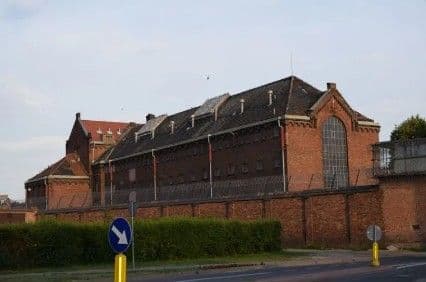 Wronki PrisonBandera was transferred in late 1937 or early 1938 from the Holy Cross prison to Wronki in western Poland. Shortly after his transfer, OUN leader Konovalets was killed on May 23, 1938, in Rotterdam. The Wronki prison had even higher security standards than the Holy Cross prison. Despite this, Ukrainians in the OUN continued to plan Bandera's release, raising money specifically for this purpose through the Ukrainian diaspora. After his release, Bandera was to be transported to Germany, whose border with Poland was only 10 kilometers from the prison.
 Wronki Prison (inside)Piotr Zaborowski, a former prison guard, was bribed and agreed to bribe a guard currently serving at the prison. Another recruited person was to help Bandera and his outsider, Kuspis, cross the Polish-German border. The entire operation was planned for September 7, 1938, but for unknown reasons, the escape failed, despite numerous hypotheses. In September, police arrested 11 people involved because Zaborowski carelessly spilled the beans to a friend, who reported the information to the police.
 Military investigative prison in Brest-on-the-BugFrom Wronki prison, Bandera was transferred in early 1939 to a prison in Brest in eastern Poland. From there, with the help of Ukrainian prisoners, he escaped to freedom on September 13, 1939. After escaping from prison, Bandera and his OUN comrades reached Lviv, where he spent a few days. After the Soviet Union attacked Poland on September 17, 1939, Bandera left Lviv for Kraków, now in the German General Government.
-500x356.jpg&w=1080&q=75) City Hall in Yavoriv (a city in Ukraine, Lviv Oblast)During this time, OUN nationalists murdered approximately 2,000 Poles in eastern Galicia, approximately 1,000 in Volhynia, and an unknown number of Jews and political opponents. For example, in Jaworów, a small town about 50 kilometers from Lviv, German troops, along with Ukrainian policemen wearing yellow and blue shoulder boards, destroyed the local synagogue and humiliated, tortured, beat, and murdered the Jews inside.
City Hall in Yavoriv (a city in Ukraine, Lviv Oblast)During this time, OUN nationalists murdered approximately 2,000 Poles in eastern Galicia, approximately 1,000 in Volhynia, and an unknown number of Jews and political opponents. For example, in Jaworów, a small town about 50 kilometers from Lviv, German troops, along with Ukrainian policemen wearing yellow and blue shoulder boards, destroyed the local synagogue and humiliated, tortured, beat, and murdered the Jews inside.
 Stepan Bandera (1909-1959 Munich)Let's return to the Bandera-related events of 1940. Bandera and other OUN members, such as Stetsko, Ianiv, Lenkavskyi, and Shukhevych, gathered in Krakow on February 10, 1940, and proclaimed the Revolutionary Leadership. Bandera became the leader of the new political body, and his faction called itself OUN-B, after Bandera, to distinguish it from the old OUN name. Similarly, the OUN-M, named after Andriy Melnyk, was formed. In Bukovina, OUN-M members carried out pogroms in towns and villages around the town of Chernovtsy (ukr. Chernivsti).
-363x500.jpg&w=750&q=75) Andrij Melnyk (1890-1964 Clervaux, Luxembourg)Like Bandera, Andrii Melnyk was extremely eager to collaborate with the Germans. On July 26, 1941, the newspaper Rahatynske Slovo published Melnyk's article titled "Ukraine and the New Order in Europe." The article included the following statement:
Andrij Melnyk (1890-1964 Clervaux, Luxembourg)Like Bandera, Andrii Melnyk was extremely eager to collaborate with the Germans. On July 26, 1941, the newspaper Rahatynske Slovo published Melnyk's article titled "Ukraine and the New Order in Europe." The article included the following statement:
[...] We collaborate closely with the Germans and invest everything in this collaboration: our hearts, feelings, all our creativity, life, and blood. Because we believe that Adolf Hitler's new order in Europe is the true order, and that Ukraine is the vanguard in Eastern Europe, perhaps the most important factor strengthening the new order. And, what is also very important, Ukraine is a natural ally of the Germans.
 Parade of Ukrainian volunteers to the SS Galizien, Sanok, May 1943During the war, Ukrainian nationalists committed horrific murders and atrocities. They were loyal supporters and fully collaborated with fascist Germany. Ukrainians could be found in the units of the murderous SS-Galizien military unit, in Gestapo prisons, in death camps, and in many other places, where they collaborated with the Germans, and often independently, tormented people and committed unspeakable crimes. Worst of all, while the crimes committed by the Germans were widely publicized after World War II, Ukrainian crimes remained largely unmentioned.
 Greek Catholic Bishop Jozafat Kocyłowski addressing Ukrainian volunteers of the 14th SS Grenadier Division, Przemyśl 1943[...] Officially, the OUN-B, led by Bandera, like the UPA, called the mass murder of Poles an "anti-Polish action," but in internal documents they used the term "purge." UPA orders even specified specific dates on which specific territories were to be "purged" of Poles. These documents often ended with the slogan "Weapons Ready—Death to Poles."
[...] The OUN-B justified the "purge" by citing proven or alleged collaboration of Poles with the German or Soviet authorities.
Another justification for the murder of Poles, according to the Bandera supporters, was the position of the Polish government in London, which considered Volhynia and Galicia to be territories that should be incorporated into the Polish state after the war. Furthermore, OUN-B members claimed that Poles living in the alleged Ukrainian territories were guilty of the centuries-long occupation of Ukraine, and this was supposed to justify their deaths at the hands of the UPA and other Ukrainians.
[...] In July 1943, one of the most violent ethnic cleansings, the OUN-B distributed leaflets accusing Poles of inciting the conflict and provoking the UPA to murder them. The OUN-B and UPA encouraged Ukrainians to seize land and property from Poles and offered them "ideology and protection against Polish revenge."
 The Jasionczak family from Wola Ostrowiecka. They were all murdered by the UPA.And what about the Poles living there?
[...] Poles living in Volhynia and Galicia didn't understand why they had to leave their homes and didn't know where to go. With the exception of military settlers who arrived in these areas after World War I, Poles had lived in Volhynia and Eastern Galicia (Eastern Lesser Poland, Lviv, Tarnopol, and Stanisławów Voivodeships) for centuries and considered this land their home. Ukrainians were their immediate neighbors. Through centuries of coexistence, the cultural differences between Poles and Ukrainians, especially in the villages, had become blurred and less significant.
Despite this, in 1943, Polish rural residents became the main target of the UPA, which was almost nonexistent in urban areas, but whose home was the villages and forests.
[...] The Holocaust of the Jews in Ukraine, in which the Ukrainian police participated, had a significant impact on the OUN-B's decision to exterminate Poles, as it demonstrated that a relatively small number of people could exterminate an entire ethnic group in a relatively short time.
This concludes episode 7, in which I spoke about the arrest of Stepan Bandera by the Polish authorities and the plans of Ukrainian nationalists to murder all Poles living in Volhynia and Eastern Lesser Poland. I cordially invite you to watch episode 8, titled "The Faithless Servant."
Photo source: Wikipedia