 PL
PL EN
EN#1Fairytale Land
The International Military Tribunal at Nuremberg and the punishment of war criminals.
I cordially invite you to the first episode of the Wolf Echoes series, titled Fairytale Land. The Wolf Echoes series is connected to the historical events of the genocide in Volhynia and Eastern Lesser Poland.
-500x331.jpg&w=1080&q=75) Reconstruction of the 1943 events in Radymno, (Agata Grzybowska)Eighty years ago, on July 11, 1943, a horrific historical event, known as Bloody Sunday, occurred in Volhynia. It was the culmination of the Volhynian massacres, a mass extermination of the Polish civilian population in Volhynia by Stepan Bandera's Organization of Ukrainian Nationalists (OUN-B), the Ukrainian Insurgent Army (UPA), and the Ukrainian civilian population. On that day, 99 towns were attacked, primarily in the Volodymyr and Horokhiv counties. In the following days, the massacres continued. This information is publicly available even on Wikipedia.
Reconstruction of the 1943 events in Radymno, (Agata Grzybowska)Eighty years ago, on July 11, 1943, a horrific historical event, known as Bloody Sunday, occurred in Volhynia. It was the culmination of the Volhynian massacres, a mass extermination of the Polish civilian population in Volhynia by Stepan Bandera's Organization of Ukrainian Nationalists (OUN-B), the Ukrainian Insurgent Army (UPA), and the Ukrainian civilian population. On that day, 99 towns were attacked, primarily in the Volodymyr and Horokhiv counties. In the following days, the massacres continued. This information is publicly available even on Wikipedia.
Can this laconic information bring back the lives of hundreds of thousands of Poles brutally murdered in those days? The criminals' cruelty was incredible and horrifying, but worst of all is the fact that the victims still cry out for the Truth, hidden by successive governments that ruled Poland after World War II, and for a Christian burial.
The Bieszczady Mountains, a beautiful hilly landscape, unforgettable views, silence, peace—in short, a land flowing with milk and honey. In the 1960s, summer camps for children were often held in the surrounding villages surrounding Sanok.
And it was during those times, and in those regions, that I happened to be a summer camper. What I remember from those days are trips to the San River, picking wild cherries in the mountain backwoods, and riding in an iron wagon pulled by a steel cable along the tracks, uphill. What sticks with me most are the cryptic words of a local guide, warning us children against hiking alone in the mountains.
When asked why, he simply stated that there might still be evil people living in the mountains, whom he called UPA gangs. He didn't reveal any more details to us children, but I sensed he was reluctant to discuss these matters. Since then, I've never heard the word UPA again.
It wasn't until almost 40 years later, in the late 1990s or perhaps the early 2000s, that I stumbled upon some information on the subject, and as I slowly discovered its significance, I understood why the guide from the Bieszczady Mountains had been so reticent.
 Survival Camp in the Bieszczady MountainsNowadays, the Bieszczady Mountains offer survival camps, meaning mountain survival. Do the people offering such attractions realize that 80 years ago, this advertising slogan represented a true life-and-death struggle for humankind, of which only a few survived?
This is, of course, the most horrific crime of genocide, unparalleled on a global scale, not because of the number of victims, although their number is estimated at around 200,000 to as much as half a million, but because of the gruesome, unimaginable cruelty of the murders perpetrated on defenseless people, primarily women, children, the elderly, and men. If someone were to ask me whether Satan exists, I would answer without hesitation that I have no doubts whatsoever, because these psychopathic criminals and degenerates in human form were certainly his messengers.
 The times of the Polish People's Republic, Poznań, June 1956Why did the Polish authorities diligently conceal the truth about the genocide for at least 40 years? Could this be justified by the fact that during the communist era, Ukraine did not exist as a state and was part of the Soviet Union? I found the answer to this question in the online Holocaust Encyclopedia, which describes the trials of various tribunals, both domestic and foreign.
 The main defendants at the Nuremberg trials in November 1945[...] On August 8, 1945, Great Britain, France, the Soviet Union, and the United States signed the London Statute, which established the International Military Tribunal (IMT) in Nuremberg, Germany, to try major German war criminals. The IMT was to try crimes against peace, war crimes, and crimes against humanity, which included acts such as "murder, extermination, enslavement, deportation... or persecution on political, racial, or religious grounds."
[...] The most famous war crimes trial held after the war was that of 22 German leaders, held at the International Military Tribunal (IMT) in Nuremberg. It began on November 20, 1945. The IMT announced its verdict on October 1, 1946; 19 defendants were found guilty and three acquitted. Among those convicted, 12 were sentenced to death, including Reichsmarschall Hermann Göring, Hans Frank, Alfred Rosenberg, and Julius Streicher. The IMT sentenced three defendants to life imprisonment and four to prison terms ranging from 10 to 20 years.
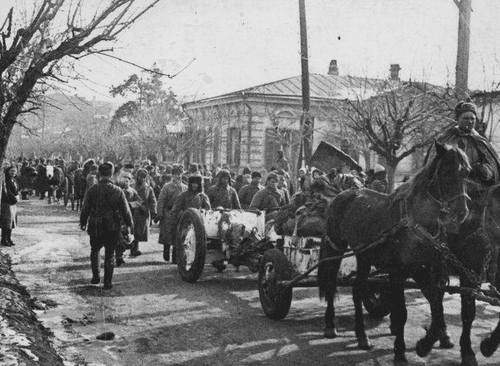 Krasnodar July 1943Immediately after the war, each of the four Allied powers occupying Germany and Austria—France, Great Britain, the Soviet Union, and the United States—put a number of perpetrators on trial for crimes committed in the territories they occupied. The defendants in the vast majority of these trials held after 1945 were Nazi officials and low-ranking officers.
This is Nuremberg, but were there other trials?
[...] Many countries occupied by Germany during World War II, or which co-opted the Germans in persecuting civilians (including Jews), also held trials of both German perpetrators and their own citizens for war crimes. Czechoslovakia, France, Hungary, Poland, Romania, the Soviet Union, and other countries brought thousands of defendants to trial. The first trial of local collaborators in the Soviet Union – the Krasnodar trial – took place in 1943, long before the end of World War II.
And what about Polish courts?
 On December 22, 1947, the Supreme National Tribunal issued a verdict in the trial of forty members of the Auschwitz concentration camp staff[...] In Poland, the Supreme National Tribunal tried 49 Nazis who committed crimes during the Nazi occupation of Poland. Among them was Rudolf Höss, the longest-serving commandant of the Auschwitz camp. He was sentenced to death and hanged in the death block at Auschwitz on April 16, 1947. The Supreme National Tribunal also tried and sentenced to death other Auschwitz officials, including former commandant Arthur Liebehenschel, as well as Amon Göth, commandant of the Płaszów concentration camp. In 1950, international unrest sparked by the Cold War relegated efforts to bring justice for World War II crimes to the background. Trials outside Germany were effectively suspended, and most of those still alive were released in the 1950s.
The above information indicates that Poland had the ability to try and prosecute war criminals, especially those responsible for the genocide in Volhynia and Eastern Lesser Poland, but why did it not take advantage of this opportunity?
Hiding the truth from Polish society is not only a moral crime and an injustice to the families of the murdered, but also criminal liability for concealing the crime. The murderers were still alive and boasting about their crimes. They could have been caught and tried, especially since many witnesses to the genocide were still alive. Even after 1989, successive governments continued to pursue this policy, harmful to Poland and deserving of the highest condemnation.
 Soldiers of the 27th Volhynian Infantry Division of the Home ArmyWe read about the first signs of this situation:
[...] It was not until the 1980s that initiatives to record these testimonies (referring to witnesses of the genocide) emerged. In February 1985, the 27th Volhynian Infantry Division of the Home Army issued an appeal to witnesses to share their memories, so it was only four decades after the genocide in Volhynia and Eastern Lesser Poland that documentation began.
Why, after the establishment of the Ukrainian state, did the Polish authorities undertake no political action or negotiations with the Ukrainian authorities to conduct a prosecutorial and judicial investigation and exhumation of the remains of the murdered Poles?
Why was the truth so carefully concealed? Was it due to political correctness, material gain, or lucrative positions? Or perhaps a utopian vision of Prometheanism, blindly embraced by successive governments? For the perpetrators of concealing the crime of genocide, regardless of their intentions, there is no justification, and in fact they are subject to criminal liability, because this crime will never be subject to a statute of limitations.
 Panzertriebwagen 16, open-air railway rolling stock museum in ChabówkaWikipedia today offers only laconic information, providing generally known facts but concealing the truth about those times.
[...] In Sanok, in November 1918, the Cossack armored train was built and later used in the Polish-Ukrainian War, and on November 2, 1918, the 3rd Sanok Rifle Battalion was formed – a Polish citizen military formation that fought against the Ukrainian Galician Army, including Sich Riflemen units.
 Residents of the Kiryłówka colony in Volhynia, most of whom were murdered by the UPA on Easter 1943And what about the defenseless population—primarily women, children, and the elderly—inhabiting Volhynia and Eastern Lesser Poland? How and with what were they supposed to defend themselves against Ukrainians, armed to the teeth by the Germans, and even their own neighbors, Ukrainian peasants armed with axes, knives, pitchforks, hoes, and saws, blinded by the lust for murder. The genocide lasted from September 17, 1939, until 1947, and even 1948, when Ukrainian nationalists of the OUN and UPA, in collaboration with and in cooperation with Ukrainian peasants, brutally murdered over 200,000 Poles. In addition to Poles, they also murdered many other nationalities living in these areas, such as Jews, Armenians, Czechs, Russians, Hungarians, and others, and even Ukrainians themselves, who opposed the murders and aided the victims of genocide.
This concludes Episode 1, in which I presented the passivity and concealment of the truth about Volhynia and Eastern Lesser Poland by the Polish authorities after World War II. I cordially invite you to the next Episode 2, titled The Ten Commandments.
Photo sources: Wikipedia