 PL
PL EN
EN#2Ten Commandments
Behind the Scenes of the Assassination of Polish Minister Bronisław Pieracki. OUN Ideology.
I cordially invite you to watch the second episode of the Wolf's Echoes series, titled The Ten Commandments. In this episode, I will discuss the murder of Polish Interior Minister Bronisław Pieracki and the Ten Commandments of the Ukrainian Nationalist.
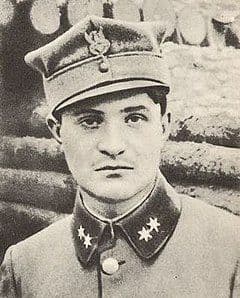 Pieracki in the legionsFirst, a few words about the murdered minister.
[...] Bronisław Pieracki was born on May 28, 1895, in Gorlice, into a family of civil servants. After the outbreak of World War I, he joined the Polish Legions, with whom he saw combat, and was severely wounded in the Battle of Jastków. He participated in the fighting against the Ukrainians for Lviv, co-organizing the city's defense. In 1928, he assumed the position of Second Deputy Chief of the General Staff, was subsequently appointed Deputy Minister of Internal Affairs, and served as Deputy Prime Minister in Walery Sławek's government. From 1931 to 1934, he served as Minister of Internal Affairs.-269x400.jpg&w=640&q=75) Bronisław Wilhelm Pieracki (1895-1934)We read about Pieracki's achievements:
Bronisław Wilhelm Pieracki (1895-1934)We read about Pieracki's achievements:
[...] Bronisław Pieracki was awarded, among others, the Virtuti Militari Order (V Class), the Cross of Independence, the Order of Polonia Restituta (IV Class), the Cross of Valor (four times), and the Gold Cross of Merit. He was posthumously promoted to the rank of brigadier general and awarded the Order of the White Eagle. The site of the assassination attempt on Pieracki – the building that housed the Social Club at 3 Foksal Street in WarsawWhat do we know about the circumstances of Pieracki's murder?
At the time of the assassination, the general held the position of Minister of Internal Affairs in the Second Polish Republic. The assassination took place on June 15, 1934, at 3 Foksal Street in Warsaw. The perpetrator of the assassination was Hryhoriy Maciejko, an activist of the Organization of Ukrainian Nationalists, commissioned by OUN leader Stepan Bandera. Hryhoriy Maciejko approached Pieracki from behind as he exited his car and headed to the government club. The assassin attempted to detonate a previously prepared bomb. When the bomb's fuse malfunctioned, he pulled out a revolver and shot the general, hitting him in the back of the head. Pieracki died from his wounds the same day, June 15, 1934.%2520%25E2%2580%2593%2520polski%2520historyk-382x500.jpg&w=828&q=75) Grzegorz Motyka (born January 29, 1967 in Ośnica) – Polish historianWhat were the motives for Pieracki's murder?
Grzegorz Motyka (born January 29, 1967 in Ośnica) – Polish historianWhat were the motives for Pieracki's murder?
[...] Historians point out that Pieracki advocated for the rational state assimilation of Ukrainians, embracing the idea of a multinational community of citizens of the Polish-Lithuanian Commonwealth, as opposed to the utopian concept of national assimilation, according to which Ukrainians would renounce their nationality. In turn, OUN activists advocated for an independent Ukraine within whose borders only Ukrainians would live. They also acted against Polish-German relations.
According to Professor Grzegorz Motyka, historian and expert on Polish-Ukrainian relations, the aim of the assassination of Pieracki, carried out during a visit to Poland by the German Minister of Propaganda, was to prevent the conclusion of a Polish-German non-aggression pact. It should be recalled that these were times of utopian Promethean ideology, promoted by the entire Piłsudski camp. The government of the Second Polish Republic was exceptionally uncritical and incredibly submissive to Ukrainian affairs, which we have an analogy of in modern times.-218x360.jpg&w=640&q=75) Stepan Lenkavsky, Ukrainian: Степан Ленкавський (1904-1977)Let us now examine the ideology of the Organization of Ukrainian Nationalists.
Stepan Lenkavsky, Ukrainian: Степан Ленкавський (1904-1977)Let us now examine the ideology of the Organization of Ukrainian Nationalists.
In 1929, a pamphlet written by Stepan Lenkavsky entitled The Decalogue of the Ukrainian Nationalist (Ten Commandments of a Ukrainian Nationalist) was published.
The creation of this Decalogue was greatly influenced by Ukrainian nationalist doctrine. The motto for the Decalogue was written by Dmytro Dontsov, author of Nationalism.
The text of the Decalogue was included in the pamphlet Catechism of the Ukrainian Nationalist, published in 1944.-307x407.jpg&w=640&q=75) Dmytro Ivanovych Dontsov, Ukrainian: Дмитро Іванович Донцов (1883-1973)What did these 10 Commandments say? In the original 1929 version, the introduction includes a reference to the Tatar era and the Cossack uprisings:
Dmytro Ivanovych Dontsov, Ukrainian: Дмитро Іванович Донцов (1883-1973)What did these 10 Commandments say? In the original 1929 version, the introduction includes a reference to the Tatar era and the Cossack uprisings:
[...] I – the Spirit of the eternal element, who saved you from the Tatar flood and placed you between two worlds, so that you could create a new life.
Then, in turn, references to nationalism, patriotism, and the liberation struggle:
Commandment 1: You will conquer the Ukrainian state or die fighting for it.
Commandment 2: You will not allow anyone to tarnish the glory or honor of your nation.
Commandment 3: Remember the great days of our liberation struggle.
Commandment 4: Be proud that you are the heir to the fight for the glory of Vladimir's Trident.
Calls for revenge:
Commandment 5. Avenge the deaths of the Grand Knights.
The need to maintain secrecy:
Commandment 6. Discuss this matter only with those you can, only with those you must.
References to the ideas of fascism and chauvinism. Praise for the worst instincts, such as hatred, deceit, and crime:
Commandment 7. You will not hesitate to commit the greatest crime when the good of the cause requires it.
Commandment 8. You will receive the enemies of your nation with hatred and deceit.
Emphasis on the need to maintain secrecy:
Commandment 9. Neither requests nor threats, torture nor death will force you to reveal secrets.
A whole range of imperialist incentives saturated with chauvinism:
Commandment 10. You will strive to expand the power, fame, wealth, and territory of the Ukrainian state, even through the subjugation of foreigners..%2520Zdj%25C4%2599cie%2520United%2520States%2520Holocaust%2520Memorial%2520Museum-500x327.jpg&w=1080&q=75) The first German soldiers returning from the conquest of Poland and France march through the Brandenburg Gate in Berlin (July 18, 1940). Photo: United States Holocaust Memorial MuseumIn short, copy-paste the ideology of fascist Germany. In the softened version from 1944, Commandments 7 and 8 were slightly changed. In Commandment 7, the greatest crime was transformed into a dangerous act:
The first German soldiers returning from the conquest of Poland and France march through the Brandenburg Gate in Berlin (July 18, 1940). Photo: United States Holocaust Memorial MuseumIn short, copy-paste the ideology of fascist Germany. In the softened version from 1944, Commandments 7 and 8 were slightly changed. In Commandment 7, the greatest crime was transformed into a dangerous act:
Commandment 7: You will not hesitate to commit the most dangerous act when the good of the cause requires it.
In Commandment 8, deception was transformed into ruthless combat:
Commandment 8: You will receive the enemy of your nation with hatred and ruthless combat.
In other sources, we read:
[...] OUN propaganda portrayed Poles as the natural enemies of the Ukrainian nation. This is confirmed by the lyrics of the song "We Were Born of the Blood of the Nation," a popular one among OUN activists, one of the verses of which reads: "Death, death, death to the Poles / Death to the cursed Muscovite-Jewish commune / The OUN leads us to a bloody battle."
NOTE: Ukrainians used the term "Lachy" to refer to Poles. That is, Death, Death to Poles, Death. The Catechism of a Ukrainian Nationalist also includes Ukrainian poetry, with phrases such as "it is not time to serve Muscovites, Lakhs" (it is not time to serve Russians and Poles).
%252C%2520obraz%2520Jana%2520Matejki%2520z%25201885%2520roku-327x500.jpg&w=750&q=75) Bohdan Khmelnytsky and Tugai Bey near Lviv (St. John of Dukla on the cloud), painting by Jan Matejko from 1885History clearly indicates that there were times before when Ukrainians, as Rusyn peoples called Cossacks, brutally murdered Poles, such as during the Cossack uprisings and the Khmelnytsky Uprising. Ukrainians grew up in a completely different culture, one that has nothing in common with Polish culture, which originated in Latin civilization. Therefore, invoking our values in relation to Ukrainians is completely false and, worst of all, detrimental to our country's interests, a fact our rulers seem oblivious to.
Bohdan Khmelnytsky and Tugai Bey near Lviv (St. John of Dukla on the cloud), painting by Jan Matejko from 1885History clearly indicates that there were times before when Ukrainians, as Rusyn peoples called Cossacks, brutally murdered Poles, such as during the Cossack uprisings and the Khmelnytsky Uprising. Ukrainians grew up in a completely different culture, one that has nothing in common with Polish culture, which originated in Latin civilization. Therefore, invoking our values in relation to Ukrainians is completely false and, worst of all, detrimental to our country's interests, a fact our rulers seem oblivious to.
I cordially invite you to episode 3, titled "Demons and Survivors."
Photo source: Wikipedia