 PL
PL EN
EN#5Helpers and Sponsors
Protectors and sponsors of the Organization of Ukrainian Nationalists.
I cordially invite you to episode 5 of the Wilcze Echa series, titled "Helpers and Sponsors." In this episode, I'll explain why the OUN, a fascist-terrorist organization hostile to Poland and Poles, grew increasingly dynamically, where it obtained its funding, and who had an interest in sponsoring it.
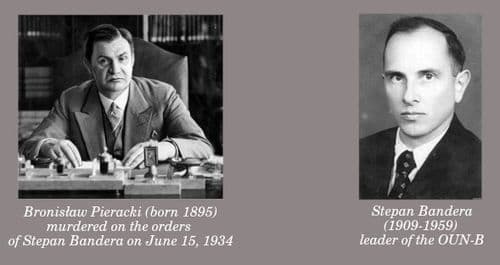 Following Pieracki's assassination in June 1934, mass arrests of OUN members began. When Bandera was arrested, the organization halted the series of murders and other propaganda campaigns, focusing instead on strengthening its structures in Volhynia. More and more Ukrainians became involved in OUN activities. Just before the outbreak of World War II, the organization had between 8,000 and 20,000 members and several thousand supporters.
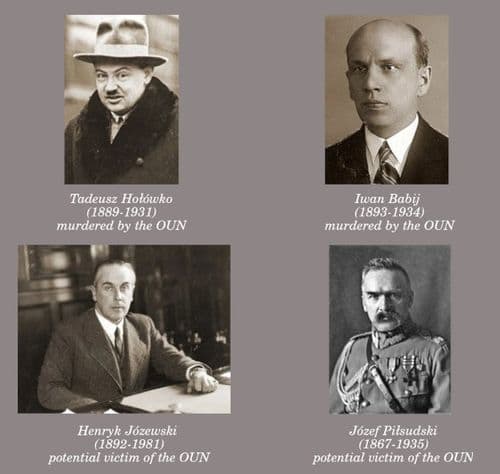 During the interwar period, the Ukrainian organizations UVO and OUN made numerous assassination attempts against Poles, Ukrainians, Jews, and Russians (not all of them successful). Among them, Bandera's members attempted to assassinate Józef Piłsudski, Foreign Minister Tadeusz Hołówko, and the governor of Volhynia, Henryk Józewski (of Ukrainian descent), as well as Ukrainians such as high school principal Ivan Babij and journalist and politician Sydir Tverdokhlib. After Bandera assumed leadership, many OUN members, such as Iakiv Bachynskyi and Maria Kovaliukivna, were murdered. The OUN viewed terror as a propaganda tool, particularly assassinations that constituted mass acts of terror.
 League of Nations flag 1939To curb the Ukrainian OUN's terror, the Polish authorities deployed the army and police. Numerous Ukrainians accused of supporting the OUN were arrested, and several were killed. The Polish authorities' action to curb the OUN's acts of terror was, for propaganda purposes, labeled a pacification operation by the OUN. This served as a pretext for the organization to file a complaint with the League of Nations about the supposedly hostile policies of the Polish government and alleged injustices inflicted on Ukrainians in Poland. Many international newspapers seized on this opportunity, creating false articles about the mistreatment of Ukrainians in Poland.
 University of Technology in Gdańsk 1904Countries like Germany and Lithuania supported the OUN's newspapers and periodicals, providing them with passports and organizing military courses for their members. Germany also supported Ukrainian nationalist student organizations at the University of Technology in Gdańsk and other universities. Thus, the OUN was dependent on Germany and Lithuania and, in return, provided these countries with espionage services. The reason Germany and Lithuania supported Ukrainian nationalists was their hostile attitude toward Poland. Germans and Lithuanians, like Ukrainians, claimed Polish territories. According to information from the Polish Intelligence Service, the OUN also collaborated with the British Secret Intelligence Service. Relations between the OUN and these supporting states were often based on cooperation between the OUN and specific institutions, for example, in Germany, the Abwehr (German military intelligence).
 Ukrainian War Veterans Association of CanadaIn addition to funds from foreign states sponsoring the OUN, Ukrainian emigrants, especially from North America, also sent money to the OUN. For example, the Ukrainian War Veterans' Association and the Ukrainian National Federation raised $40,000 for the OUN between 1928 and 1939. Additional revenue for the OUN came from loot from bank robberies, post offices, and private individuals in Poland.
 The German delegation signs the Treaty of Versailles, 1919One important reason why the OUN collaborated with Germany was the political order following the Treaty of Versailles after World War I. Because Germany had lost much territory, it sought to reverse the geopolitical order established by the Allies. At the same time, Ukrainians were in a worse situation because the Treaty left them without a state and made Germany their most important partners. Two events that influenced, but did not interrupt, cooperation between the OUN and Germany were the German-Polish Non-Aggression Pact signed on January 26, 1934, and the assassination of Minister Pieracki by the OUN on June 15, 1934.
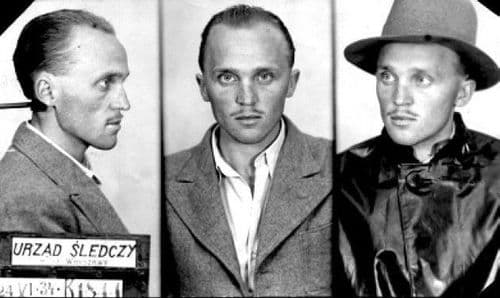 Mykola Lebed 1934On the day of Pieracki's murder, the German Minister of Propaganda (Joseph Goebbels) was on an official visit to Warsaw. Mykola Lebed, suspected of involvement in organizing Pieracki's assassination, fled to Germany through the Free City of Danzig. Despite friendly relations between the Germans and Ukrainians, he was extradited to Poland at the request of Józef Lipski, the Polish ambassador in Berlin. Lebed was arrested after disembarking in Szczecin and handed over to Polish authorities on the personal orders of Reich Chancellor Adolf Hitler, without a formal extradition request from Poland. He was flown by a special plane to Warsaw. After the trial began on November 18, 1935, Lebed, along with Stepan Bandera, was sentenced to death by the Warsaw District Court on January 13, 1936, a verdict commuted to life imprisonment under an amnesty, along with the permanent loss of public and civil rights. Could this be the end of the Ukrainian OUN? Probably not... On September 5, 1939, Lebed escaped from a prisoner evacuation transport in Siedlce. As you might guess, with the help of sponsors.
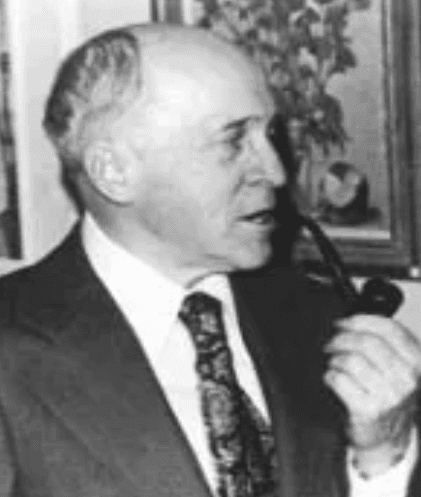 Mykola Lebed in CanadaWhat next? Did he hide somewhere in South America or Alaska? Nothing of the sort... From November 1939 to March 1940, Lebed was the commandant of the intelligence and sabotage school established by the Abwehr at the initiative of the OUN in Zakopane. After a split in the OUN in 1940, he became the first head of the newly formed Security Service and a delegate for negotiations with the Third Reich authorities. He held the position of head of the Security Service until March 1941, when he was replaced by Mykola Arsenych.
How did Mykola Lebed, a Ukrainian nationalist, war criminal, murderer, and also responsible for the genocide in Volhynia, end his life? Unfortunately, it wasn't a death sentence or a prison cell. Thanks to his protectors in the United States, he lived to the ripe old age of 89, undisturbed, and died on July 18, 1998, in Pittsburgh, Pennsylvania, USA. After the signing of the non-aggression pact, German politicians promised not to cooperate with the OUN. However, both the Abwehr and Lithuanian politicians continued to cooperate with the OUN in the second half of the 1930s.
This concludes episode 5, in which I spoke about some of the supporters and sponsors of the Organization of Ukrainian Nationalists (OUN), and the fate of a Ukrainian criminal from the OUN who was protected by overseas protectors.
I cordially invite you to episode 6, titled "Ukrainian Spaghetti."
Photo source: Wikipedia