 PL
PL EN
EN#4Devil's Secret
Establishment of the Ukrainian Military Organization and the Organization of Ukrainian Nationalists.
I cordially invite you to watch the fourth episode of the Wolf Echoes series, titled The Devil's Secret. In this episode, I will discuss the origins of the criminal Organization of Ukrainian Nationalists and answer the question: Why is the cult of Bandera, currently practiced in Ukraine, so deadly, especially for us Poles?
 Greek Catholic Church in Uchrynów StaryTo understand the criminal ideology of the Ukrainian nationalists of the OUN and why the cult of Bandera poses such a deadly threat to us Poles, we must first travel back in time 117 years to 1909, the year of the birth of one of its infamous proponents and leaders. Stepan Bandera was born on January 1, 1909, in the village of Staryi Uhryniv, located in eastern Galicia.
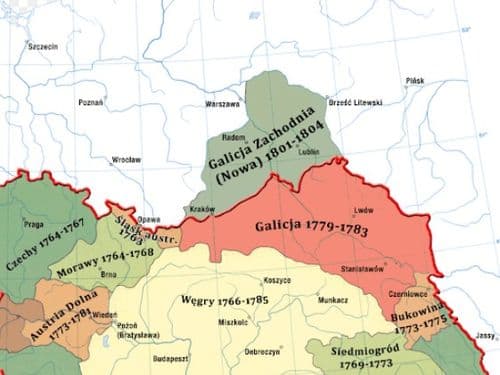 Map of Galicia 1779-1783Galicia, officially known as the Kingdom of Galicia, was created by bureaucrats of the House of Habsburg in 1772 during the first partition of the Polish-Lithuanian Commonwealth.
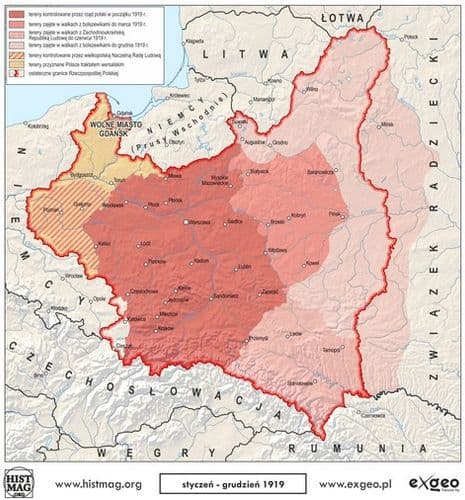 The Second Polish Republic in 1919According to statistics from 1910, 62% were Ukrainians, 25% were Poles, and 12% were Jews.
At the time of Bandera's birth, approximately 20% of Ukrainians began to identify as Ukrainians, living in the Habsburg Empire. At the same time, 80% of Ukrainians lived in the Russian Empire. This division, along with other political, religious, and cultural differences, meant that Galician Ukrainians became a completely different people from Ukrainians in Russian Ukraine. When the Second Polish Republic was established in 1918, ethnic Poles constituted approximately 65% of the population, with the remainder being national minorities such as Ukrainians, Jews, Germans, Lithuanians, Belarusians, and Russians. As for the Ukrainian population, 5 million lived in the territory of the Second Polish Republic, 26 million in the Ukrainian Soviet Socialist Republic, 0.5 million in the Czechoslovak Republic and 0.8 million in Romania (Greater Romania).
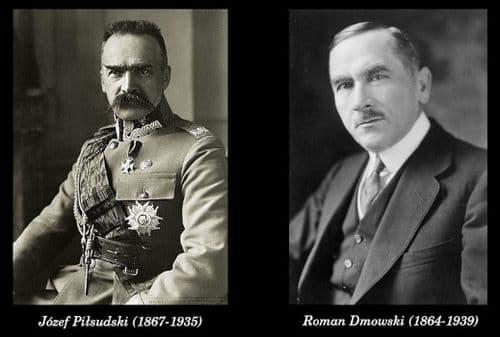 Sanacja and Endecja in the Second Polish RepublicWhat was the Polish government's primary goal towards Ukrainians?
Piłsudski's Sanacja and Dmowski's Endecja represented two distinct policies towards Ukrainians and national minorities in the Second Polish Republic. The Sanacja supported the principle of state assimilation, while the Endecja advocated national assimilation. National assimilation required minorities to become Poles and abandon their language and culture, while state assimilation did not seek to abandon cultural values but required loyalty to the Polish state.
Such loyalty conflicted with the interests of Ukrainians from Galicia and Volhynia, who neither wanted to become Poles nor to be loyal to the Polish state. As a result, even the liberal and leftist wings of Polish politicians within the Sanacja movement, which attempted to improve Polish-Ukrainian relations, never ceased to teach Ukrainians loyalty to the Polish state in order to maintain a stable order in the Second Polish Republic.
 Ukrainian National Democratic AllianceWere there any Ukrainian organizations in the Second Polish Republic during the interwar period?
Ukrainian nationalists and their illegal organizations were not the only political organizations in the Second Polish Republic during the interwar period. The main Ukrainian political party in Poland was the Ukrainian National Democratic Alliance (UNDO), founded in 1925. UNDO believed that Polish rule in western Ukraine was illegal, but it participated in parliamentary elections, respected the law of democracy, and rejected terror.
-369x500.jpg&w=750&q=75) Vasyl Mudryi (1893-1966)What was the attitude of Ukrainians towards the Germans?
Vasyl Mudryi (1893-1966)What was the attitude of Ukrainians towards the Germans?
By the late 1930s, most Ukrainians living in Poland began to see Nazi Germany as a future liberator and ally. After 1939, even democratic politicians like Vasyl Mudryi, who had previously condemned violence, fascism, and national hatred, began to collaborate with Nazi Germany and saw the OUN as an important liberating force. They hoped that Germany would destroy Poland and give Ukrainians a chance to establish their own state.
%252C%2520przewodnicz%25C4%2585cy%2520Organizacji%2520Ukrai%25C5%2584skich%2520Nacjonalist%25C3%25B3w%2520(OUN)-288x375.jpg&w=640&q=75) Yevhen Konovalets, co-founder and commander of the Ukrainian Military Organization (UWO), chairman of the Organization of Ukrainian Nationalists (OUN)What Ukrainian nationalist organizations were formed?
Yevhen Konovalets, co-founder and commander of the Ukrainian Military Organization (UWO), chairman of the Organization of Ukrainian Nationalists (OUN)What Ukrainian nationalist organizations were formed?
In 1920, Ukrainian SICH Riflemen veterans Andrii Melnyk and Roman Sushko founded the Ukrainian Military Organization (UWO) in Prague. Its goal was to continue the fight for a Ukrainian state, but it became a terrorist organization. It obtained its funding from espionage missions for other countries. Ultimately, they founded the OUN at the First Congress of Ukrainian Nationalists, held in Vienna from January 28 to February 3, 1929.
What were the goals of these organizations?
The main political goal of both the Ukrainian People's Army (UWO) in the 1920s and the OUN in the 1930s was to mobilize the Ukrainian masses for a revolution, which was intended to provoke a violent conflict between Ukrainians and their perceived occupiers, whom they considered Poles and Russians. Their enemies were all non-Ukrainians, especially Jews, Poles, and Russians. They viewed and persecuted Ukrainians who did not share the OUN's vision, especially those collaborating with the Polish authorities. One of their enemies was the UNDO, the largest Ukrainian party in the Second Polish Republic, which sought the creation of a Ukrainian state through legal means.
 Generations of the Organization of Ukrainian NationalistsWhat was the structure of the Ukrainian OUN?
The OUN organization was divided into two generations: the older generation for members born around 1890 and the younger generation for those born around 1910.
The older generation of the OUN included individuals such as Ievhen Konovalets (1891-1938), Andriy Melnyk (1890-1964), and Riko Iaryi (1898-1969). The younger generation of the OUN included Stepan Bandera, Iaroslav Stetsko (1912-1986), Stepan Lenkavskyi (1904-1977), Volodymyr Ianiv (1908-1991), and Roman Shukhevych.
 Creators and propagators of Ukrainian fascismThe main propagators of fascism in the OUN in the 1930s were Mykola Stsiborskyi and Yevhen Onatskyi, who, like Dontsov, worked on the concept of Ukrainian fascism.
a-367x500.png&w=750&q=75) Andriy Melnyk (1890-1964)Andrii Melnyk, who succeeded Konovalets as leader of the OUN, was a supporter of fascism.
Andriy Melnyk (1890-1964)Andrii Melnyk, who succeeded Konovalets as leader of the OUN, was a supporter of fascism.
In a letter to Joachim von Ribbentrop dated May 2, 1938, Melnyk claimed that the OUN was "ideologically similar to movements in Europe, especially National Socialism in Germany and Fascism in Italy."
The younger generation adopted various fascist principles, including the leader principle. They committed spectacular acts of terror, encouraged by older members of the exiled leadership, who used propaganda to raise funds for Ukrainians living in North America. They promoted terror as a patriotic struggle, committing acts of assassination against the occupiers. At the April 1933 conference in Berlin, Konovalets formally rejected Bandera's proposal to use terror, but he made no attempt to curb the terrorist acts of the younger generation. Besides assassinations, the OUN committed numerous other acts of terror. For example, from July 12 to September 24, 1930, the OUN set fire to Polish farmers' crops and rural buildings, as well as destroying railway tracks and telecommunications lines.
 Ukrainian OUN terrorist Mykola Lemyk during the trial for the murder of Alexei Maylov, 1933Ukrainian nationalist organizations had members in both villages and smaller towns in Galicia and Volhynia, where they killed people not only for political but also economic and other reasons. By 1922, the UWO had set fire to 2,200 Polish farms. In 1937 alone, the OUN carried out 830 acts of terror against Polish citizens or their property. Of these acts, 540 were classified by the security services of the Polish Ministry of Internal Affairs as anti-Polish, 242 as anti-Jewish, 67 as anti-Ukrainian, and 17 as anti-communist. It is estimated that several thousand people fell victim to the Ukrainian UWO and OUN during the interwar period.
I cordially invite you to watch episode 5, titled "Helpers and Sponsors."
Photo source: Wikipedia