 PL
PL EN
EN#26Light at the End of the Tunnel
The Volhynian Massacre Monument in Domostawa. The Genocide of Poles and the Rise of Ukrainian Nationalism.
 The Volhynian Massacre monument in DomostawaDear friends, a very important moment in the history of contemporary Poland has arrived. The truth has finally pierced the veil of deception, and on July 14, 2024, the long-awaited "Volhynian Massacre" monument by master Andrzej Pityński was unveiled in Domostawa.
This magnificent monument commemorates the genocide perpetrated by Ukrainians against Poles in Volhynia. The unveiling ceremony was attended by several, perhaps even tens of thousands, of people, and included a mass led by Father Antoni Moskal, an advocate for commemorating the victims of the Ukrainian genocide in Volhynia.
Many reports about the unveiling ceremony have appeared online. The monument is magnificent, moving, and reflects a fragment of true history that occurred over 80 years ago, actually beginning in 1939 and lasting until 1947 (and even 1948).
 Genocide of Poles in Volhynia 1943The murders committed by hordes of Ukrainian peasants led by Ukrainian nationalists from the OUN and bandits from the UPA are horrific and have no parallels in any crimes committed on our planet to date. Equally horrifying is the fact that the murders were primarily defenseless children, women, and the elderly, carried out by Ukrainians armed with axes, pitchforks, knives, saws, and firearms. The genocide was meticulously planned and executed. Not only Poles were murdered, but also other nationalities living in Volhynia and Eastern Lesser Poland. Ukrainians who attempted to save the victims from certain death often suffered the same fate as the victims.
-378x500.jpg&w=828&q=75) Wilhelm Franz Canaris (1887-1945)The Ukrainian 14th Waffen SS Grenadier Division (formed in the spring of 1943) also participated in genocidal crimes, as did the Wehrmacht "Nachtigall" Battalion (German: Battalion Ukrainische Gruppe Nachtigall), composed of Ukrainians and Germans. The Nachtigall unit was established at the initiative of the OUN at the congress of the Organization of Ukrainian Nationalists in 1940. German Admiral Wilhelm Canaris approved the formation of this criminal organization on February 25, 1941.
Wilhelm Franz Canaris (1887-1945)The Ukrainian 14th Waffen SS Grenadier Division (formed in the spring of 1943) also participated in genocidal crimes, as did the Wehrmacht "Nachtigall" Battalion (German: Battalion Ukrainische Gruppe Nachtigall), composed of Ukrainians and Germans. The Nachtigall unit was established at the initiative of the OUN at the congress of the Organization of Ukrainian Nationalists in 1940. German Admiral Wilhelm Canaris approved the formation of this criminal organization on February 25, 1941.
-374x500.jpg&w=750&q=75) Lew Rebet (1912-1957)
Lew Rebet (1912-1957)-357x500.jpg&w=750&q=75) Jarosław Stećko (1912-1986)
Jarosław Stećko (1912-1986)
The initiative to establish the Naghtigall Battalion was associated with a group of civilians from the leadership of the OUN-B (B for Bandera): Yaroslav Stetsko (1912-1986), designated by Bandera as head of the government of the "liberated" Ukraine, Lev Rebet (1912-1957), Yaroslav Starukh (1910-1947), Ivan Ravlyk (1909-1942), Mykhailo Pavlyk, Stepan Lenkavsky and Dmytro Yatsiv (1907-1942).
 Eastern Lesser Poland and VolhyniaAccording to official history, the OUN's goal was to fight Poland, Romania, and the USSR to create an independent Ukraine, extending from the Don River to Lesser Poland, by, among other things, separating the Lviv, Ternopil, and Stanisławów voivodeships from the Polish state.
The problem was that the OUN sought to establish an independent Ukrainian state on all lands it considered Ukrainian, by annexing, without seeking the opinion of the peoples inhabiting these territories.
-163x222.jpg&w=384&q=75) Joseph Goebbels (1897-1945)Internationally, the OUN was part of the fascist international known as the Congress of Foreign National Socialists, based in Stuttgart and under the patronage of Joseph Goebbels. SS formations, including the 14th Waffen SS-Galizien Division, were deemed a criminal organization by the International Military Tribunal at Nuremberg in 1945. It should be emphasized that Ukrainian collaboration with the Germans began much earlier, even before the official founding of the Organization of Ukrainian Nationalists in 1929.
Joseph Goebbels (1897-1945)Internationally, the OUN was part of the fascist international known as the Congress of Foreign National Socialists, based in Stuttgart and under the patronage of Joseph Goebbels. SS formations, including the 14th Waffen SS-Galizien Division, were deemed a criminal organization by the International Military Tribunal at Nuremberg in 1945. It should be emphasized that Ukrainian collaboration with the Germans began much earlier, even before the official founding of the Organization of Ukrainian Nationalists in 1929.
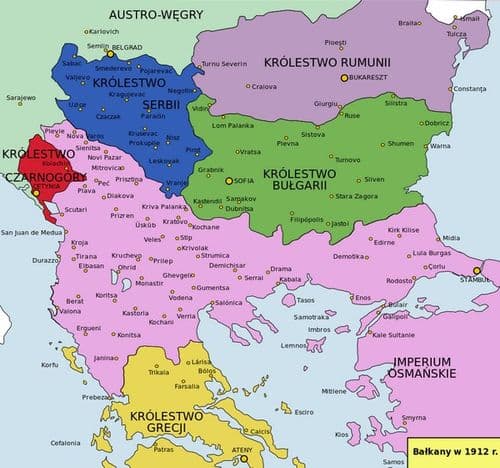 The territory of the Balkans in 1912At the beginning of the 20th century, two armed conflicts broke out in the Balkans.
[...] The first was a multinational war of liberation against Turkey. The second conflict erupted over the division of territories previously seized from the Ottoman Empire. Bulgaria, dissatisfied with the division of lands, initiated the war, but yielded to a coalition of neighboring states.
%2520pod%2520pomnikiem%2520Franti%25C5%25A1ka%2520Palackiego%2520podczas%2520zjazdu%2520w%2520Pradze%25201912-500x276.jpg&w=1080&q=75) Members of the Ukrainian Sokol (paramilitary organization) at the monument of František Palacký during the Prague rally in 1912
Members of the Ukrainian Sokol (paramilitary organization) at the monument of František Palacký during the Prague rally in 1912%252C%25201923-189x221.jpg&w=384&q=75) Young Stepan Bandera in a Plast uniform (a paramilitary organization), 1923
Young Stepan Bandera in a Plast uniform (a paramilitary organization), 1923
These conflicts provided an opportunity for Ukrainian nationalism.
[...] In 1912, Ukrainian nationalist, radical, and social democratic activists convened a conference on December 11, 1912, which declared Ukrainian loyalty to Austria-Hungary. It was also decided that Ukrainian associations (such as the Sich, Sokil, and Plast) would begin to form paramilitary units.
Note that Ukrainian collaboration with Austria-Hungary (Germany) began even before the outbreak of World War I in 1914.
Shortly after the outbreak of World War I, Ukrainians formed the Main Ukrainian Council from previously existing Ukrainian organizations: the Ukrainian National Democratic Party (founded in Galicia in 1899), the Ukrainian Radical Party (founded in Lviv in 1890) and the Ukrainian Social Democratic Party (founded in 1899).
 The Habsburg Monarchy in the 16th century. It existed from 1526 to 1804. From 1867, Austria-Hungary dissolved after World War I in 1918.Established on August 1, 1914, the Main Ukrainian Council:
[...] On August 3, 1914, it issued a servile manifesto, in which it declared its loyalty to the Habsburg Monarchy. It called on the Ukrainian nation to fight alongside Austria-Hungary and Germany against Russia for the liberation of Dnieper Ukraine and for the liberation of Ukrainians in Eastern Galicia from Polish oppression.
When Russian troops occupied Dnieper, Ukrainian activists of the Council moved to Vienna,
[...] collaborating there with the Union for the Liberation of Ukraine.
 Legion of Ukrainian Sich Riflemen, a Ukrainian military formation within the Austro-Hungarian ArmyVery quickly, in August 1914, the Council established the Ukrainian Military Board (Ukrainian: Ukrayinska Boeva Uprawa, UBU),
[...] which requested permission from the Austro-Hungarian government to form Ukrainian armed units. Approval was granted, and on August 6, 1914, the Council issued a manifesto establishing the Legion of Ukrainian Sich Riflemen.
On May 5, 1915, the Main Ukrainian Council, located in Vienna, changed its name to the General Ukrainian Council.
Historical facts clearly indicate not only collaboration, but close cooperation between Ukrainian nationalists and the Austro-Hungarian government and Germany, directed against Russia and the Poles, even before the rebirth of the Polish state after 123 years of partition.
-284x441.jpg&w=640&q=75) Greek Catholic Metropolitan Andrei Sheptytsky (1865-1944)In addition to Ukrainian nationalists, the German "Ukraine" project also involved many Greek Catholic clergy, led by Andrzej Sheptytsky, who called for murder and the confiscation of property and land from Polish residents of Volhynia and Eastern Lesser Poland. Many soldiers and officers from the 14th Waffen SS Grenadier Division became Greek Catholic priests after training.
Greek Catholic Metropolitan Andrei Sheptytsky (1865-1944)In addition to Ukrainian nationalists, the German "Ukraine" project also involved many Greek Catholic clergy, led by Andrzej Sheptytsky, who called for murder and the confiscation of property and land from Polish residents of Volhynia and Eastern Lesser Poland. Many soldiers and officers from the 14th Waffen SS Grenadier Division became Greek Catholic priests after training.
In an interview on August 4, 2020, Father Moskal recounted that before the Ukrainians attacked the village of Borownica, a disgusting ritual was performed in Javornik Ruski, which he called the "Polish Panikhida."
[...] Panikhida (Ukrainian: Panakhida) is the name of the rite of burial in the Greek Catholic Church.
 Court of Justice in The HagueThe brutality of the Ukrainian genocide against Poles is so horrific that it should be revealed to the world, so that no one ever even considers repeating this horrific history. The indictment, the demand for justice and the identification of the perpetrators, and the exhumation of the murdered Poles, should reach the Court of Justice in The Hague, and the case of genocide should be proclaimed not only in Poland but also throughout the world.
The monument to Master Pityński in Domostawa is not an act of revenge against Ukrainians, but reveals the Truth and serves as a warning to those who adhere to the nationalist and chauvinistic Bandera ideology and all its manifestations that there is no place for them in Poland, and will never be. More such monuments should be erected in all major Polish cities, and above all in Warsaw, and the flags of a foreign state adhering to an ideology hostile to ours, flying from Polish offices, should be removed immediately.
It is a misunderstanding to expect an apology from Ukrainians for the crimes of their ancestors, because these crimes cannot be forgiven, but economic relations can be established after Ukrainians recognize the historical truth, renounce the Bandera ideology and allow the exhumation of murdered Poles.
-408x500.jpg&w=828&q=75) Feliks Karol Koneczny (1862-1949)Already 100 years ago, Feliks Koneczny wrote that
Feliks Karol Koneczny (1862-1949)Already 100 years ago, Feliks Koneczny wrote that
[...] Apologies or regret for past crimes are not in the nature of the peoples of the Turanian civilization, for whom the morality, ethics, and other values of Latin civilization do not exist.
 Light at the end of the tunnelThe monument in Domostawa is the first glimmer of truth at the end of a tunnel filled with deception and hypocrisy, deliberately created by the creators of the World of Illusion surrounding us. Many questions remain, awaiting answers that could reveal the full truth about the genocide committed against Poles in Volhynia and Eastern Lesser Poland.
No representatives of higher secular or church authorities (with the exception of representatives of the Confederation) attended the unveiling ceremony of the monument in Domostawa, which may indicate the involvement of those absent in the "Ukraine" project. Master Pityński's monument is a huge drop of truth in the "cup of bitterness" that has been slowly filling since 1989, and the time is coming for change, undoubtedly initiated by this magnificent monument.
With this installment, I conclude the series of articles entitled "Wolf Echoes," but I will continue to search for the truth hidden in the vast and virtually inaccessible archives of the American, British, Israeli, Ukrainian, and German intelligence services. Despite the difficulties in understanding the Truth, the monument in Domostawa is a testament to the fact that the Truth exists; we just need to strive to discover it.
Best regards,
Author: Jan Balcewicz