 PL
PL EN
EN#25Eye of the Cyclone
The development of the ideology of the Organization of Ukrainian Nationalists in Ukraine in modern times.
%2520Beaufort%2520(1774-1857)-415x500.jpg&w=1080&q=75) Francis Beaufort (1774-1857)Over 250 years ago, on May 27, 1774, in Navan, County Meath, Ireland, Frank Beaufort was born. From an early age, he was fascinated by the sea, and at thirteen, he joined the East India Company as a cabin boy. A year later, he joined the Royal Navy as a cabin boy. The young cabin boy soon blossomed into an officer in the English Royal Navy named Francis Beaufort.
Francis Beaufort (1774-1857)Over 250 years ago, on May 27, 1774, in Navan, County Meath, Ireland, Frank Beaufort was born. From an early age, he was fascinated by the sea, and at thirteen, he joined the East India Company as a cabin boy. A year later, he joined the Royal Navy as a cabin boy. The young cabin boy soon blossomed into an officer in the English Royal Navy named Francis Beaufort.
Francis served on numerous ships of the English Navy, including the Colossus, Latona, and Aquilon. By the age of 22, he was already a lieutenant, and in 1800, he became captain of the HMS Phaeton. He was wounded during battles with French ships and had to undergo rehabilitation on land. Only after more than two years, in 1805, was he given command of the frigate HMS Woolwich.
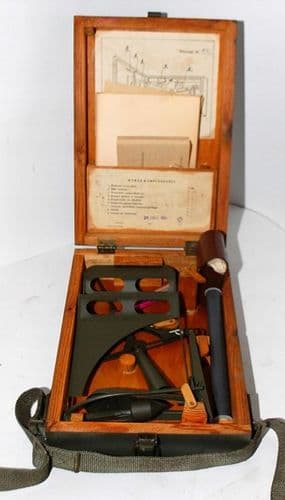 Tretyakov's Meteorological SetWhile serving on the frigate, Francis began keeping a meteorological journal and continued his weather notes until his death in 1857. He developed the first version of the Beaufort scale, still used today, and in 1829 was appointed hydrographer in the Royal Navy. Francis's career did not end with the rank of captain, as he was knighted (Sir Francis Beaufort) in 1848 and retired with the rank of admiral in 1853.
The wind force scale and the sea near Alaska are named after him. The Beaufort scale has 12 levels, which indicate wind force, sea state, and associated phenomena on land. For example, 0 indicates a smooth sea, calm seas, and vertical smoke rising on land, while 12 indicates enormous waves, a white sea covered with spray, and massive and widespread structural damage on land.
-374x500.jpg&w=750&q=75) Herbert Seymour Saffir (1917-2007)
Herbert Seymour Saffir (1917-2007)-247x338.jpg&w=640&q=75) Robert H. Simpson (1912–2014)
Robert H. Simpson (1912–2014)
The Beaufort scale, while undoubtedly very useful in describing weather conditions, proved ineffective in studying large-scale atmospheric phenomena like tropical cyclones. Therefore, 112 years after Beaufort's death in 1969, engineer Herbert Saffir and National Hurricane Center Director Bob Simpson developed the Saffir-Simpson scale, used for storms in the Atlantic and North Pacific Oceans east of the International Date Line. This scale classifies hurricanes by the intensity of their sustained winds and allows for an estimate of potential damage upon landfall.
 Cyclone Bhola, Category 3 on the Saffir-Simpson scale, Ganges estuary, half a million victims, November 12, 1970A tropical cyclone develops over warm waters, moves over the oceans, and is the most intense energetic phenomenon in the atmosphere. Cyclones are associated with low-pressure systems and cause air masses to circulate clockwise in the Southern Hemisphere and counterclockwise in the Northern Hemisphere. The most catastrophic tropical cyclone in recorded history was Cyclone Bhola, which devastated Bangladesh in 1970, killing at least 300,000 people. Hurricane Mitch struck Central America in the fall of 1998, causing several thousand deaths. In September 2005, Hurricane Katrina flooded New Orleans and devastated Mississippi.
Tropical cyclone descriptions distinguish five weather zones, ranging from 0 to 4. The outer zones include zone 0 and 1, where, despite pressure fluctuations, the weather is quite bearable. The next zone, zone 2, has gale-force winds, and zone 3, hurricane-force winds. At the very center of the cyclone, zone 4, called the eye of the cyclone, is located.
 Eye of the stormHere, winds are light or even calm. The sky can be overcast or covered with clouds, with a hint of blue sky between them. Large mountains of water appear on the sea surface, rising and falling chaotically in complete silence. This is seemingly the safest place, but hurricane-force winds rage nearby, and to make matters worse, the cyclone isn't stationary at all, but is moving in various directions. It turns out that tropical cyclone weather descriptions can be used to describe phenomena that have little to do with weather.
 The Waffen-SS Galizien monument at Oakville Cemetery, Canada, was removed on March 7, 2024.After World War II, a sudden lull descended on Poland, as if in the eye of a hurricane, but that didn't mean the mortal danger from Ukrainians had passed. We know from previous articles what happened beyond Poland's borders, in the West, after World War II, in the United States, Canada, Great Britain, and many other countries. We know about the development of the nationalist-chauvinist ideology of the OUN by the Ukrainian diaspora, and the subsequent homage and propagation of the cult of Stepan Bandera beyond Ukraine's borders. We also know which Ukrainians, and thanks to whom, found their "Eldorado" there, escaping the hand of justice that never reached them.
 December 1, 1991, referendum on Ukrainian independenceYou could say that the West is our western cyclone zone, but what about the eastern side, Ukraine?
[...] On August 24, 1991, during the collapse of the Soviet Union, the Ukrainian Parliament declared the existence of an independent Ukrainian State. The declaration was confirmed on December 1, 1991, by 90.3% of the population.
Here's what happened to the OUN and UPA before 1991:
[...] The OUN and UPA returned to Ukraine in the late 1980s as anti-Soviet icons. Fallen OUN activists and UPA partisans were promoted as national dissidents and far-right politicians, a resistance movement, and the last post-war warriors against the "red devil." Their collaboration with Nazi Germany, their anti-Semitism and fascist ideology, their participation in the Holocaust and other forms of mass violence during and after World War II have been completely forgotten.
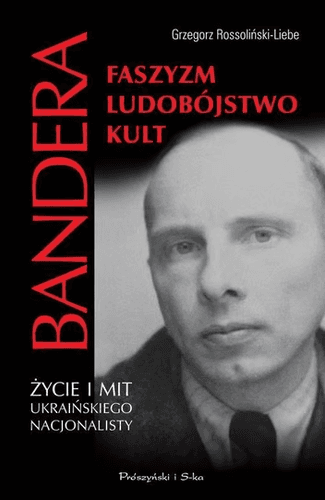 A book about Stepan Bandera by a Polish historian (Grzegorz Rossoliński-Liebe, born in 1979 in Zabrze)The cult of Stepan Bandera has emerged at lightning speed, this time in Ukraine, like a new cyclone called Bandera.
Grzegorz Rossoliński-Liebe, a Polish-German historian based in Berlin, writes about the birth of this cult in his book "Stepan Bandera: The Life and Afterlife of a Ukrainian Nationalist Fascist Fascist, Genocide, and Cult":
[...] The revival of the cult of Bandera in post-Soviet Ukraine, representing the cult of a fascist and despotic leader, is not a relic or an isolated phenomenon typical of German neo-Nazism or other far-right groups promoting racism and hatred.
[...] The cult of Bandera in Ukraine has taken on many more diverse forms than those created by the diaspora during the Cold War. In Ukraine, this cult is popularized by politicians, historiography, museums, novels, films, monuments, street names, political events, music festivals, bars, food, stamps, media discussions, and much more.
-315x397.jpg&w=640&q=75) Stepan Bandera (1909-1959)Initially, in 1989 and 1990, Soviet propaganda was active, viewing Bandera as one of the main symbols of Ukrainian nationalism and conducting anti-nationalist propaganda campaigns. At the same time, Ukrainian nationalists were conducting propaganda in newspapers. For example, an article in Pravda Ukrainy referred to Bandera as the "Great Son of the Ukrainian Nation."
Stepan Bandera (1909-1959)Initially, in 1989 and 1990, Soviet propaganda was active, viewing Bandera as one of the main symbols of Ukrainian nationalism and conducting anti-nationalist propaganda campaigns. At the same time, Ukrainian nationalists were conducting propaganda in newspapers. For example, an article in Pravda Ukrainy referred to Bandera as the "Great Son of the Ukrainian Nation."
Speeches were also given. During one of them, the leader of the Association of Independent Ukrainian Youth said:
[...] The ideas Stepan Bandera fought for are still present today. These are the ideas of nationalism, the revolutionary movement in Ukraine. We, the young generation of nationalists, are arming ourselves with these ideas.
In 1990, at the 28th Congress of the Communist Party of Ukraine, a debate was held on whether the OUN and UPA should be rehabilitated. Ultimately, the Stalinist terror was condemned and it was decided not to rehabilitate the OUN and UPA yet.
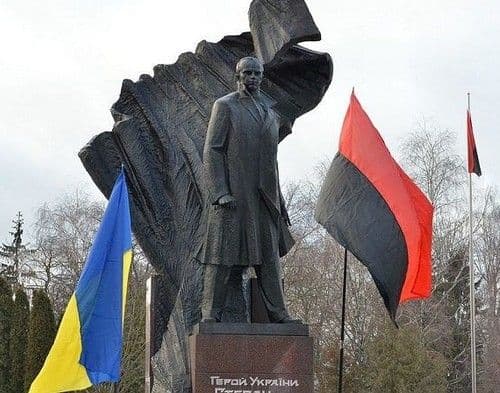 Monument to Stepan Bandera in KyivCyclone Bandera was gaining speed, and monuments and museums to the late Providnyk began to spring up across Ukraine like mushrooms after the rain.
[...] On October 15, 1989, on the 30th anniversary of Bandera's death, seven young people—four men and three women—from Stryi and Lviv erected a bronze cross.
The KGB failed to arrest these individuals because they were hidden by local residents.
[...] On May 27, 1990, nationalists poured the base for the monument in front of the house where Bandera was born. The monument was built at a cement factory in Dubivtsi and transported to Staryi Uhryniv by taxi.
 Stepan Bandera Regional Museum of the Liberation Struggle, Ivano-Frankivsk, UkraineThe monument, erected on the night of October 13-14, 1989, featured a bust of Bandera on two pillars with a bell below. On the same day as the Bandera monument's unveiling, the first Bandera museum in Ukraine opened. Ten thousand Ukrainians attended the museum's opening ceremony. The museum was located in the house of Volya Zaderevatska, where the Bandera family lived from 1933 to 1936. Also on the same day, October 14, the statue of Lenin in Lviv was toppled. Note the highly efficient and financially demanding organization, propaganda, and dismantling of Cyclone Bandera.
The first Bandera statue did not last long, being blown up on December 30, 1990. However, less than a year later, on June 30, 1991, the monument was rebuilt. The new monument was slightly taller, and instead of a bell, two tridents were placed beneath the bust. The unveiling of the statue was attended by 10,000 Ukrainians (possibly well-paid extras), some dressed in Ukrainian folk costumes and carrying yellow, blue, and red-black flags. As one might imagine, many more monuments and commemorative plaques were erected in Ukraine.
[...] With the rise of nationalism following the dissolution of the Soviet Union, the OUN and UPA became a significant component of the identity of western Ukraine.
 The Stepan Bandera Museum in Uhrynów StaryIn 2018, in Uhrynów Stary, the village where Providnyk was born, an arson attempt was made on the Stepan Bandera museum. The private company "Nako Inwest" won the tender for the renovation. Eduard Dolinski, director of the Ukrainian Jewish Committee, who was interested in the renovation, stated that the funds for the museum's renovation, approximately PLN 3 million, would come from state funds. However, he did not specify which state he was referring to.
[...] The Soviet Union was no longer perceived as Ukraine's main enemy, and Ukrainians' hatred was directed against left-wing groups, Russian-speaking eastern Ukrainians, and occasionally the European Union.
Far-right nationalists began to claim that Ukraine was occupied by democrats, Russians, or Russified eastern Ukrainians who should be Ukrainized or Banderized.
[…] Many Western Ukrainians complained that Ukraine was dependent on Russian culture, economics, politics, radio, television, and language. They also claimed that those who criticized Bandera, the OUN, and the UPA were afflicted with Banderophobia, which they defined as hostile tendencies directed against Ukrainian culture.
The rise of nationalism and radical right-wing activism led to ethnic and political persecution and violence. It is difficult to estimate how many people fell victim to nationalist violence, which caused many Russians and Jews to leave or attempt to leave Ukraine. There are numerous reports describing the persecution of non-Ukrainians.
Here is an excerpt from one of them:
[...] Irina Khtchetinin, an ethnic Russian and Jewish woman living in Lviv, decided to leave Ukraine with her husband and three children after a radical right-wing group attacked her Jewish-Russian neighbors.
According to historian Jeffrey Burds, who led the investigation, Irina's neighbors were brutally tortured in their own apartment.
[...] Her husband was burned with a hot iron, and his wife's eye was gouged out, while the attackers shouted anti-Russian and anti-Jewish epithets. The Ukrainian police did not even file a report on the attack or undertake any investigation.
Countless historical books, essays, memoirs, and other forms of propaganda have been published, presenting fabricated or biased events, portraying Stepan Bandera, the OUN, and the UPA as heroes, liberators, or even idols of Ukrainians.
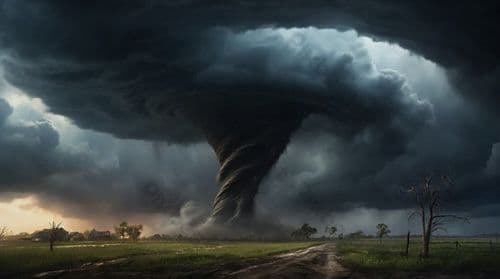 Image of a cycloneThe cult of Bandera, pervading every aspect of Ukrainian reality, is like a cancer spreading throughout Ukraine, destroying any signs of resistance or rebellion against his ideology. It is also like a powerful tropical cyclone, constantly changing direction and devastating everything in its path.
So we have a complete picture of the cyclone: on the left, the Western countries and the Ukrainian diaspora, and on the right, Ukraine with its "fans" of a sick ideology directed against Poles, Jews, and Russians living not only in Ukraine. The Ukrainian Nationalist Organization has resurfaced in Ukraine once again, and Ukrainian politicians in Kyiv are openly proclaiming pro-Bandera slogans.
 Open door policyUkrainians were let into Poland through the gates wide open by the current government, led by former President Andrzej Duda. The next government, led by Prime Minister Donald Tusk, is pursuing the same open-door policy. The long-established Ukrainian 5th column is gaining strength, and acts of terror and violence are occurring across our country. Ukrainians are demanding the return of supposedly ethnically Ukrainian lands, known as Zakerzonia, while Poland remains as quiet as the eye of Bandera's hurricane.
[...] The term "Zakerzonian Land" was used in OUN-B journalism and UPA nomenclature.
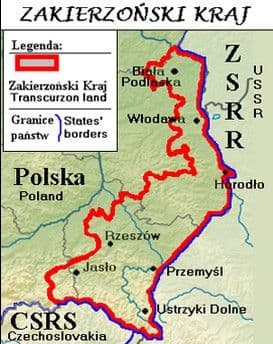 Zakerzonian Land, an area of Poland allegedly belonging to ethnic Ukrainians, claimed by descendants of the OUN and UPA.Poles are largely unaware of the impending danger, with government puppets, more aptly named Chucky dolls, bringing in ever-increasing numbers of Ukrainians to our country. The anti-Polish policies pursued by the authorities must lead to a change in the entire ethnic structure of our country, and Ukrainians, whose numbers are growing, pose a very real and significant threat in the near future.
 The image of Poland in the eye of the Bandera cycloneAll it takes is for Cyclone Bandera, sustained and often praised in the supposedly Polish media, to change its course and strike directly at our poor homeland. Therefore, under no circumstances, nor by the agitation of government politicians, can we allow ourselves to be drawn into war, especially on the Ukrainian side.
This concludes Episode 25, in which I discussed the cult of Stepan Bandera in contemporary Ukraine. Poland is still in the eye of the Bandera cyclone, but dark clouds are approaching, heralding an imminent change in its direction. I cordially invite you to watch the final Episode 26, titled Light at the End of the Tunnel.
Photo source: Wikipedia