 PL
PL EN
EN#24Unexpected Ally
Defense of the Polish population of the Eastern Borderlands against Banderites, UPA gangs and Ukrainian peasants.
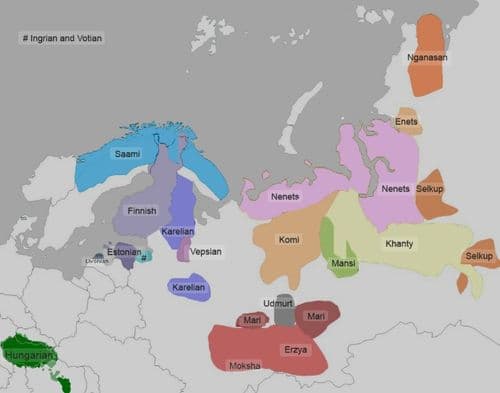 Finno-Ugric peoplesOver 2,500 years ago, in the mid-1st millennium BCE, the Ugric community collapsed. During this period, a nation emerged so mysterious that to this day, scholars are tearing their hair out to unravel its enigmatic origins. Interestingly, this nation inhabits a territory approximately 100 km from Poland's southern border. This is, of course, the Hungarian nation, whose native term was "magyar," recorded in Muslim sources from the 9th and 10th centuries.
The word "magyar" is a compound of the words "madž" and "er." Although the origins of both words are completely different (Indo-European, Finno-Ugric), both share the same meaning of "human." It has been suggested that the name "magyar" arose from the fusion of two Ugric peoples: the "speaking people" and the "incomprehensible people," or "mute people."
 The Huns in the times of the Roman EmpireEuropeans don't recognize the native Hungarian word "magyar," but believe their name comes from a combination of the Bulgarian-Turkic words "onogur," meaning "ten tribes," dating back to the 5th century A.D. At that time, the Magyars were closely linked to the Huns and Proto-Bulgarians, who together formed the Onogur tribe. The Slavs, in turn, added the letter "w" to the beginning, creating the word "wonogur," which still bears little resemblance to the word "hungarian."
 Geographical distribution of the Uralic family languagesAfter long and painstaking research, scholars have finally concluded that Hungarians belong to the Uralic peoples, a branch of the Finno-Ugric language, a sub-branch of the Ugric language. I don't know if this explains the already complex origins of Hungarians, and perhaps it would be simpler to say that the closest relatives of Hungarians today are the Khanty and Mansi people living in Western Siberia, and their common origins are only attested by the similarity of their languages.
There are currently 14.5 million Hungarians worldwide, with Hungary alone having around 10 million inhabitants. Neighboring countries, such as Romania, Slovakia, Serbia, Ukraine, Austria, and Croatia, have 2.5 million Hungarians. There is also a large Hungarian diaspora, primarily in the United States (1.5 million), Germany (120,000), and Great Britain (80,000) (these population figures are only approximate).
-500x307.jpg&w=1080&q=75) Hungary after World War I (1918-1919)The Hungarian nation is culturally and ethnically homogeneous. During World War II, Hungary, like Italy, Romania, Bulgaria, Slovakia, Ukraine, and Lithuania, collaborated with the Germans. In this article, I will discuss the Hungarian collaboration with the Germans and the attitude of Hungarians towards citizens of the Second Polish Republic during World War II.
Hungary after World War I (1918-1919)The Hungarian nation is culturally and ethnically homogeneous. During World War II, Hungary, like Italy, Romania, Bulgaria, Slovakia, Ukraine, and Lithuania, collaborated with the Germans. In this article, I will discuss the Hungarian collaboration with the Germans and the attitude of Hungarians towards citizens of the Second Polish Republic during World War II.
 Defenders of Lviv, Lviv Eaglets, 1918After the successful defense of Lviv by its residents and the Lviv Eaglets, Ukrainians were dissatisfied with the situation.
[...] In the reborn Polish-Lithuanian Commonwealth, they began sabotaging activities aimed at the Polish state. In the 1920s, Ukrainian organizations and parties with a national character were established, including the National Organization of the City of Lviv and UNDO – the Ukrainian National Democratic Union.
Let us recall how the Organization of Ukrainian Nationalists (OUN) was founded:
[...] In 1929, the Organization of Ukrainian Nationalists (OUN) was established in Vienna, proclaiming the slogan of fighting for a free Ukraine alongside Germany. Operating based on fascist models, it steadily expanded its influence, and over time, Lviv became its main branch.
-401x500.jpg&w=828&q=75) Dmytro Dontsov (1883-1973)The organization was based on Dmytro Dontsov's doctrine. It promoted the slogan that the future Ukrainian state should be ethnically homogeneous and organized on authoritarian principles. According to the principle that:
Dmytro Dontsov (1883-1973)The organization was based on Dmytro Dontsov's doctrine. It promoted the slogan that the future Ukrainian state should be ethnically homogeneous and organized on authoritarian principles. According to the principle that:
[...] different species cannot coexist within one territory; the weaker should give way to the stronger.
-341x500.jpg&w=750&q=75) Stepan Bandera (1909-1959)Achieving this goal permitted the use of any means, including ethnic cleansing. Stepan Bandera, a "zealous believer" in the new methods, soon took power in the OUN.
Stepan Bandera (1909-1959)Achieving this goal permitted the use of any means, including ethnic cleansing. Stepan Bandera, a "zealous believer" in the new methods, soon took power in the OUN.
Ukrainians from Stepan Bandera's OUN-B committed numerous terrorist acts, primarily against the Polish population. Under Stepan Bandera's rule, "daily revolutionary work" developed.
[...] From September 1933, in almost every rural school in the Eastern Borderlands of Poland, Polish national symbols and portraits of state dignitaries were thrown out of classrooms at night. For Bandera, the school boycott was an expression of protest against Polonization and the alleged restrictions on the development of Ukrainian education.
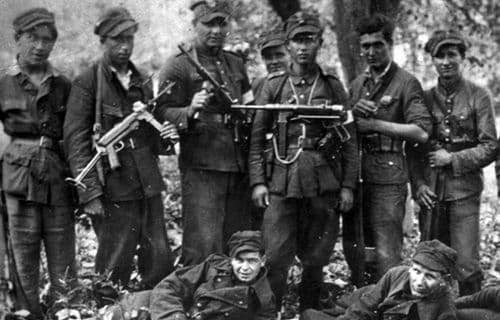 Soldiers of the Home ArmyThe Home Army (AK) reported on Ukrainians' hostile attitudes toward Poles:
[...] In July 1943, the Home Army reported that Ukrainian peasants said that after the Jews, "Poles will be next." That same month, the Home Army noted that the slogan "Death to the Poles" (Ukrainian: Smert' liakham) had become popular among Ukrainians in Lviv, even being used as a daily greeting. [...] That same month, the Home Army in Stanisławów observed Ukrainians greeting each other with the words "Death to the Poles," and the response was "Glory to Ukraine."
Here's an excerpt from a Polish woman's account from that time:
[...] Janina Kwiatkowska traveled in January 1945 with two sisters from Ternopil to Chortkiv. They had to spend the night in the provincial town of Terebovlia and didn't want to stay overnight at the train station. In Ukrainian, which they spoke as fluently as Polish, they asked a Ukrainian woman to let them stay overnight in her home. The woman mistook them for Ukrainians and agreed. When the women asked her where her husband was, the Ukrainian woman replied carelessly, "He's gone off to murder Poles and will be back soon." In her testimony, Kwiatkowska used the term "Banderite" to refer to the Ukrainian woman's husband.
 Self-Defense Soldiers in the Eastern Borderlands of the Second Polish RepublicHere's what the Poles' defense against the OUN, UPA, and Ukrainian peasants looked like:
[...] Poles attempted to defend themselves against the Ukrainians by forming self-defense units. The Home Army also tried to aid the Poles, but with little success, as the number of UPA partisans and mobilized Ukrainians far outnumbered the Home Army and the Poles in the self-defense.
In any case, the Polish government in London failed the Poles in Volhynia and Eastern Lesser Poland by failing to stop the acts of genocide committed by Ukrainians. Operation Vistula, organized in 1947, one of the goals of which was to deport the Ukrainian and Lemko populations living in these areas, was carried out too late.
%2520Wis%25C5%2582a%25201947-500x319.jpg&w=1080&q=75) Action (Operation) Vistula 1947It's worth noting that as a result of Operation Vistula, the Ukrainian population living in the Eastern Borderlands of the Second Polish Republic was resettled primarily to the northwestern territories of the Second Polish Republic.
Action (Operation) Vistula 1947It's worth noting that as a result of Operation Vistula, the Ukrainian population living in the Eastern Borderlands of the Second Polish Republic was resettled primarily to the northwestern territories of the Second Polish Republic.
It can be surmised that this Ukrainian group of resettlers included a significant portion of the Ukrainian peasantry, infected with the ideology of nationalism, chauvinism, and hatred of Poles. Moreover, this group certainly included Ukrainian executioners of Polish women, children, and the elderly from Volhynia and Eastern Lesser Poland.
-317x365.jpg&w=640&q=75) Józef Klemens Piłsudski (1867-1935)Due to the earlier harmful actions of the Polish authorities, and especially after 1926, the Sanation government of Józef Piłsudski, a huge Ukrainian minority existed in Poland, having access not only to government offices, military and intelligence institutions, but also to political spheres.
Józef Klemens Piłsudski (1867-1935)Due to the earlier harmful actions of the Polish authorities, and especially after 1926, the Sanation government of Józef Piłsudski, a huge Ukrainian minority existed in Poland, having access not only to government offices, military and intelligence institutions, but also to political spheres.
As a result of Operation Vistula, after 1947, additional crowds of Ukrainians, most of them hostile towards Poles, flooded our country. Some sources indicate that there were also numerous cases, particularly in Lviv, when Ukrainians murdered Poles in order to obtain Polish documents and use them to change their identities.
As I wrote in the article "The Polesian Secret," Red Soviet partisan units defended Poles against Banderites and the bandits of the Polesian Sich. Given the massive scale of these brutal murders, could we still count on any allies? It turns out there was an ally who, despite collaborating with the Third Reich, resolutely sided with Poland against the Ukrainians of the OUN and UPA. This ally was the Hungarians. Here are a few selected historical facts from World War II related to Hungary.
-270x340.jpg&w=640&q=75) Pál Teleki (1879-1941)The Hungarians refused to participate in the attack on Poland in September 1939. Furthermore, Hungarian Prime Minister Pál Teleki threatened the Germans that:
Pál Teleki (1879-1941)The Hungarians refused to participate in the attack on Poland in September 1939. Furthermore, Hungarian Prime Minister Pál Teleki threatened the Germans that:
[...] if they wanted to force their way through Hungarian territory, they would rather blow up their own railways than participate in the invasion of Poland.
The Hungarians also decided to open their borders to refugees from Poland. Tens of thousands of civilians found refuge on their territory.
[...] Thanks to the tacit consent of Budapest, a significant portion of the soldiers were able to move further west to form a new Polish army there.
The policy of Pál Teleki's government was to balance between the Third Reich and the Allies. To this end, it concluded a non-aggression pact with Yugoslavia.
[...] Throughout, the Hungarians tolerated Polish activity on their territory: Polish schools and cultural institutions operated. Couriers carrying documents from London to the occupied country also traveled freely. In this way, Hungary was to remain neutral during World War II for as long as possible.
 Hungarians, friends of Poles in VolhyniaA few words about the Hungarian army's activities in Volhynia:
[...] Hungarian army units stationed in Volhynia in 1943 helped Poles protect them from the UPA by providing food and supplies. Hungarians often helped Polish refugees from burned villages to migrate to Hungary.
One of the witnesses to the events there, Wincenty Romanowski, recalled that Poles saw Hungary as true friends and allies against the UPA and the war against the Germans.
[...] Every Sunday, a large Hungarian unit came to the church for Mass, the soldiers sang their hymns, and the Polish state emblem hung above the chancel.
Places where Hungarian troops were stationed, such as Wiśniowiec Nowy, served as havens for Poles. Ukrainians sometimes attacked villages located near Hungarian troops. If the Hungarians failed to prevent Ukrainian attacks in time, they retaliated. One report from the underground leadership, dated August 3, 1943, states:
[...] Ukrainians captured by the Hungarians had their hands bound with wire and murder weapons attached to them, which they used to murder Poles. These Ukrainians were then transferred to Lviv.
 Hungarian and Polish soldiers in VolhyniaThe National Party, operating underground, viewed the Hungarians' attitude toward the Poles very positively. There was unspoken cooperation between Polish and Hungarian units. The Hungarians supplied the Poles with weapons and ammunition in exchange for other items. According to reports from June 1944, the Hungarians independently liquidated Ukrainian gangs, not handing over prisoners to the Germans, who customarily released them the next day.
In January 1944, Poles defending the rural population were attacked by a strong UPA unit, and at a critical moment, a Hungarian company with armored vehicles arrived to help, forcing the Ukrainians to retreat.
[...] The Hungarian unit was called upon to assist by a German named Szerenc, who after the battle organized the transport of wounded Poles to Lviv. The question arises: why did the Hungarians help the Poles and not, for example, the Lithuanians, with whom we were once connected by the Polish-Lithuanian Commonwealth?
%252C%2520w%25C4%2599gierskiej%2520ksi%25C4%2599%25C5%25BCniczki%252C%2520%25C5%25BCony%2520polskiego%2520ksi%25C4%2599cia%2520Boles%25C5%2582awa%2520V%2520Wstydliwego-319x465.jpg&w=640&q=75) Icon of St. Kinga (1234-1292), Hungarian princess, wife of the Polish prince Bolesław V the ChasteHistory provides the answer to this question.
Icon of St. Kinga (1234-1292), Hungarian princess, wife of the Polish prince Bolesław V the ChasteHistory provides the answer to this question.
Friendly relations between Hungarians and Poles began as early as the 10th century, when Hungary and the Polish-Lithuanian Commonwealth adopted Christianity. Hungarians and Poles were united by numerous military alliances and battles against common enemies. In 1108, thanks to an alliance with Hungary, the Poles repelled the attack of the German Emperor Henry V. Hungarians and Poles fought together against the Tatars and the Teutonic Knights. The Polish-Lithuanian Commonwealth was dynastically linked to Hungary through the marriage of Saint Kinga, daughter of the Hungarian King Béla IV, to Bolesław the Chaste. Thanks to a personal union during the reign of Władysław III of Varna (15th century), Hungarians and Poles put up a joint resistance against the Ottoman Empire. Poles also fought alongside Hungary in the Hungarian Uprising of 1848, under the leadership of General Józef Bem. We also encountered Hungarians during the Polish-Soviet War (1919–1921), when they supplied the Poles with weapons and ammunition.
The establishment of March 23 as Polish-Hungarian Friendship Day is a testament to the friendly Polish-Hungarian relations.
 Prime Minister of Hungary, Viktor Orbán (born 1963)In modern times, there has been an inexplicable shift in the "Polish" government's attitude toward Hungarians, and particularly toward Hungarian Prime Minister Viktor Orbán. It seems that the foreign policy pursued by the Hungarian statesman should serve as an example for our rulers. Protecting one's country's interests and maintaining economic relations with neighbors is clearly alien to politicians from Poland, who are based on the utopian and outdated idea of neo-Prometheanism. Allowing the ethnic structure of our small empire to change through the uncontrolled admission of millions of Ukrainians, historically our enemies for centuries, to Poland could lead to a situation where we will be forced to turn to the Hungarians for help in the future.
This concludes episode 24, in which I presented the true defenders of Poles against the Bandera followers and the UPA gangs. It's surprising that Hungarians are rarely mentioned in supposedly Polish media or historical literature, even though it was the Hungarians who were our true allies during World War II. "Polish" rulers foster a myth of friendship with Ukrainians, the British, and Americans, despite historical experience clearly contradicting such a foreign policy. I cordially invite you to watch episode 25, titled "Eye of the Storm."
Photo source: Wikipedia