 PL
PL EN
EN#19Mirage of Power
Events in Ukraine after the victory of Euromaidan.
 Location of the Kingdom of Phrygia, Roman provinces in Asia MinorIn 711 BCE, over 2,700 years ago (2736), the legendary king of Phrygia invaded the sandy Anatolian and Syrian coasts of the Mediterranean Sea. Anatolia is a historical region in Turkey encompassing the entire peninsula of Asia Minor and parts of the lands to its east. Its name comes from the Greek word "Anatole," meaning "East." Anatolia or Anatola is also a female name of Greek origin, meaning "coming from the east or eastern."
The invading forces of the king of Phrygia were joined by small states of southern Anatolia. The opponent of the allied forces led by the king of Phrygia was Sargon II, who led the Assyrian forces. Six years earlier, in 717 BCE, Sargon II had defeated the Assyrian forces. he captured Carchemish (a city in Syria, on the right bank of the Euphrates) and, gradually defeating the allies of the king of Phrygia, stopped his expansion.
 King Midas, ruler of the Kingdom of PhrygiaThe figure of the Phrygian king was considered legendary until recently, but it is confirmed in Assyrian sources, and his name was Midas. Although Midas died in battle against the Cimmerians (a nomadic Indo-European people originating from Crimea) fleeing the Scythians (nomadic Iranian people from the area between the Altai and the lower Volga), who had invaded Anatolia, he survived as the hero of numerous legends, myths, and anecdotes.
One myth attributed Midas with exceptional stupidity. According to the story, he rescued the lost Silenus from Dionysus' retinue heading to India. As a reward, Dionysus promised to fulfill one wish of the king. The king asked that everything he touched be turned to gold. However, Midas quickly realized he was in danger of starvation – bread and wine also turned to gold. The final straw was that he also transformed his beautiful daughter into a golden statue. Terrified, he begged Dionysus to forfeit his gift. He had only to wash his head and hands in the waters of the Pactolus River, which from then on became rich in gold.
 King Midas with donkey earsIn another myth, Midas was the judge of a musical contest between Apollo and Marsyas. Because he judged Marsyas's playing more beautifully, the god punished him with donkey ears. From then on, the unfortunate king always wore a turban to protect himself from ridicule. Only the court barber knew about his secret, but Midas forbade him to reveal it under penalty of death. The servant, however, could not bear it; he wanted to confide in someone. So he went to the seaside, dug a small hole in the sand, and shouted, "King Midas has donkey ears!" He quickly filled the hole and left, calm. After a while, a clump of reeds grew in its place. When the wind blew, the reeds whispered, "King Midas has donkey ears!" As a result, the entire country soon learned of the ruler's shameful secret. The legendary Midas, despite being a king, was not particularly intelligent, and his power was quite illusory, even despite his ability to turn anything into gold. It is precisely this illusion of power, this time not that of King Midas, that I will discuss in this article.
-369x484.jpg&w=750&q=75) Viktor Fedorovich Yanukovych (born 1950)Ultimately, the power struggle on Maidan Square ended with the departure of President Viktor Yanukovych (presidential period 2010-2014) and his closest associates from Kyiv for eastern Ukraine and then to Russia.
Viktor Fedorovich Yanukovych (born 1950)Ultimately, the power struggle on Maidan Square ended with the departure of President Viktor Yanukovych (presidential period 2010-2014) and his closest associates from Kyiv for eastern Ukraine and then to Russia.
According to estimates, the coup in Ukraine claimed the lives of approximately 100 so-called Maidan activists, self-defense members, and militiamen. Over 1,200 people were injured, nearly 800 of whom were hospitalized. Interior Ministry forces lost nearly 30 people, and approximately 800 officers and soldiers of the Internal Troops were wounded.
-408x341.jpg&w=828&q=75) Yulia Tymoshenko (born 1960)The previously negotiated agreement became null and void, and the Maidan and the "opposition" seized power in Ukraine, violating the law and the constitution. The Verkhovna Rada adopted an unlawful resolution declaring that the president had arbitrarily resigned from his duties and set the date for early presidential elections for May 25, 2014. Under a special procedure also unknown under current law, Yulia Tymoshenko was released from prison.
Yulia Tymoshenko (born 1960)The previously negotiated agreement became null and void, and the Maidan and the "opposition" seized power in Ukraine, violating the law and the constitution. The Verkhovna Rada adopted an unlawful resolution declaring that the president had arbitrarily resigned from his duties and set the date for early presidential elections for May 25, 2014. Under a special procedure also unknown under current law, Yulia Tymoshenko was released from prison.
 United States Department of State Headquarters, H.S. Truman Building, Foggy Bottom, Washington, USAThe US Department of State supported the new authorities in Kyiv by delivering approximately 330,000 MRE (Meal Ready to Eat) dry food portions in 20 varieties to Ukrainian soldiers by truck.
The Ukrainian government requested military assistance from the United States in the form of weapons, ammunition, communications equipment, aviation fuel, night vision goggles, and intelligence support. However, the Americans refused this type of assistance so as not to further antagonize Moscow.
Chaos reigned in Ukraine. It was unclear who held the real power on the ground. A struggle for the country's unity and control over the law enforcement agencies began. In the west, groups associated with the Maidan movement remained active, while in the east and south, the Maidan law was emulated by Moscow-backed, pro-Russian demonstrators. Ukraine found itself at a crossroads, plunged into chaos that, in the long term, threatened to completely destabilize the country.
%252C%2520ukrai%25C5%2584ski%2520polityk%2520i%2520przedsi%25C4%2599biorca%2520pochodzenia%2520ormia%25C5%2584skiego-500x430.jpg&w=1080&q=75) Arsen Borisovych Avakov (born 1964 in Baku), Ukrainian politician and entrepreneur of Armenian originOn the night of March 14-15, 2014, further armed clashes broke out in Ukraine. In Kharkiv, Right Sector rebels opened fire on pro-Russian protesters. Two people were killed, and five others were wounded and hospitalized. In response, Arsen Avakov, the new Minister of Internal Affairs, called on March 16 for citizens to immediately surrender unregistered weapons, ammunition, and explosives.
Arsen Borisovych Avakov (born 1964 in Baku), Ukrainian politician and entrepreneur of Armenian originOn the night of March 14-15, 2014, further armed clashes broke out in Ukraine. In Kharkiv, Right Sector rebels opened fire on pro-Russian protesters. Two people were killed, and five others were wounded and hospitalized. In response, Arsen Avakov, the new Minister of Internal Affairs, called on March 16 for citizens to immediately surrender unregistered weapons, ammunition, and explosives.
The regulations stated that, regardless of political affiliation or participation in public law enforcement:
[...] All those who fail to comply with the law will be punished with the utmost ruthlessness.
-500x424.jpg&w=1080&q=75) Arseniy Petrovych Yatsenyuk (born 1974)The dramatic events unfolding at the Maidan in Kyiv deepened Ukraine's dire economic situation. Industrial production plummeted, exports declined, not only to the Russian market, and foreign exchange reserves also dwindled. Kyiv found itself on the brink of bankruptcy.
Arseniy Petrovych Yatsenyuk (born 1974)The dramatic events unfolding at the Maidan in Kyiv deepened Ukraine's dire economic situation. Industrial production plummeted, exports declined, not only to the Russian market, and foreign exchange reserves also dwindled. Kyiv found itself on the brink of bankruptcy.
Incumbent Ukrainian Prime Minister Arseniy Yatsenyuk said in late March 2014 that his country would not supply Russia with weapons, ammunition, or military equipment. At the same time, he declared that his cabinet would strive to technically modernize Ukraine's defense industry so that it could cooperate with the West.
These facts further confirm that the Euromaidan was orchestrated by elites from overseas.
-383x500.jpg&w=828&q=75) Petro Oleksiyovych Poroshenko (born 1965)Petro Poroshenko, a renowned oligarch known as the "King of Chocolate," became President of Ukraine. He was the legendary Midas who turned everything into gold, while Poroshenko's specialty is chocolate.
Petro Oleksiyovych Poroshenko (born 1965)Petro Poroshenko, a renowned oligarch known as the "King of Chocolate," became President of Ukraine. He was the legendary Midas who turned everything into gold, while Poroshenko's specialty is chocolate.
His news channel, Channel 5, actively supported the Maidan protests.
Poroshenko also owns:
The Korrespondent weekly and the bigmir.net website, Bohdan Corporation, one of Ukraine's largest manufacturers of passenger cars and trucks, and the largest manufacturer of buses; ISTA Company, the largest battery manufacturer in the CIS; and Roshen Corporation, the largest manufacturer of confectionery and candy products in Ukraine, with plants also in Russia and Lithuania.
Poroshenko held very senior positions in the Ukrainian government.
In 2005, he served as Secretary of the National Security and Defense Council during the Yulia Tymoshenko era, as well as Minister of Foreign Affairs and Minister of Economic Development and Trade.
 One of the pro-Banderite demonstrations in UkraineThe question arises: what was the purpose of oligarch Petro Poroshenko's pro-EU, pro-American, and anti-Russian actions?
[...] It is believed that an Association Agreement with the EU would increase sales of his products to EU markets by 10-40%. Today, confectionery products are subject to customs duties and fees of 35-40%.
It turns out that false ideology often helps in business, as was the case with Petro Poroshenko.
A group of pro-American and pro-EU politicians has seized power in Ukraine, in accordance with the plans of Kermit in Washington and the wishes of the eminences grise in Brussels. Thus, power in Ukraine no longer belongs to the nation, but to the people, many of whom are descendants of members of the OUN and UPA, as evidenced by demonstrations commemorating Ukrainian criminals.
 President Andrzej Duda's visit to Kyiv, May 2022What was the reaction of the Polish media and the then-government in Poland to the events following Euromaidan?
[...] In Poland, most analysts, journalists, and politicians uncritically approved of the coup that took place there. This was accompanied by primitive anti-Russian and war propaganda. Meanwhile, it was obvious that not everything that was happening in and around Maidan was aligned with Poland's strategic interests. Increasing tensions in the region, losing markets for low-volume products, and exposing our country to ruthless political infighting involving foreign intelligence services could only bring disastrous consequences.
-248x311.jpg&w=640&q=75) Jack F. Matlock Jr. (born 1929)It turns out that not all American diplomats supported the plans implemented by the command center in Washington.
Jack F. Matlock Jr. (born 1929)It turns out that not all American diplomats supported the plans implemented by the command center in Washington.
Jack Matlock, a diplomat specializing in Soviet affairs and the US ambassador to Moscow from 1987 to 1991, said in an interview with the Polish Press Agency that:
[...] Ukraine would be better off without Crimea. Its residents strongly supported people like Viktor Yanukovych in the elections, who opposed reforms. In 1991, the US supported the independence of the three Baltic states, but believed that the other republics would be better off in a voluntary federation established after the Soviet Union. The US hoped that Mikhail Gorbachev would succeed in creating a voluntary federation. We believed that if Ukraine seceded, it would not be a successful state.
-377x500.jpg&w=828&q=75) George Walker Bush in 2003 (born 1946)Earlier, President George Bush had delivered a speech in Kyiv on August 1, 1991, in which he warned against suicidal nationalism.
George Walker Bush in 2003 (born 1946)Earlier, President George Bush had delivered a speech in Kyiv on August 1, 1991, in which he warned against suicidal nationalism.
[...] Bush told Ukrainians not to confuse freedom with independence. He said: choose freedom, but they chose independence. Thus, a country divided by history and language was created.
 New NATO headquarters, Brussels, Belgium. The combined armed forces of all NATO members total approximately 3.5 million soldiers and personnel.Matlock proposed a three-part solution for Ukraine:
[...] First, there must be a genuine international effort, including Russia, to try to hold them together, with the hope that Ukrainians will find a leader who can do this.
[...] Second, Ukraine should adopt a federal system in which each province would elect its own governor and have its own education system and other laws, modeled on, for example, American states or German federal states.
[...] Third, there needs to be an honest commitment from the West that Ukraine will never become a member of NATO.
 Belarus, Ukraine, GeorgiaThe politician spoke openly about Russia's concessions to NATO expansion pressure:
[...] Russia agreed to NATO expansion to include Central European countries, including Poland and the Baltic states. But we went further and further, and when the question of Ukraine and Georgia's membership arose, we crossed a red line.
Matlock concluded his statement with disarming honesty:
[...] But let's admit it. If this concerned the West's sphere of influence and our border, we would have reacted sooner. I don't know why most Americans don't understand this? Let's also remember that Russia is a nuclear power, and no one with common sense would use force against a nuclear power.
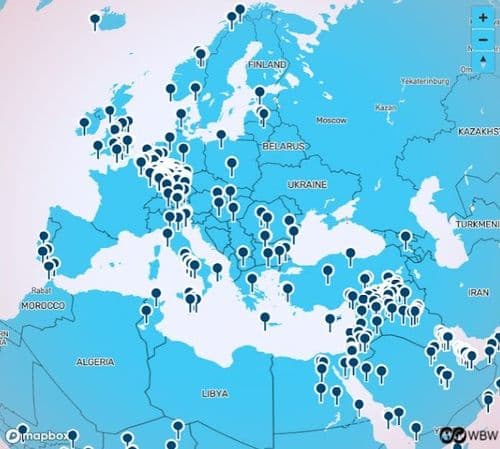 United States military bases in EuropeMatlock unequivocally confirmed that the United States has long been conducting activities directed against Russia, particularly through the deployment of American military bases in countries surrounding the Russian Federation. In Europe, the Americans have bases in Germany, Italy, the United Kingdom, Poland, and Romania. Sources confirm military training of Ukrainians in America (including in Poland), the sending of American military specialists to Ukraine, the provision of military equipment, weapons, and logistical support dictated by Washington elites, as well as the City of London from the United Kingdom, and to a lesser extent, Germany and France. The Kyiv authorities carry out the orders of their sponsors with great zeal. They support and exploit the activities of extremely nationalist Ukrainian organizations promoting the cult of Ukrainian criminals from the OUN and UPA. Ukrainians have never actually governed their own country, much less defended Polish borders or Polish interests. The slogan "it's not our war" is undoubtedly true and justified, despite the outcries of government officials playing the roles of crazed pyrotechnicians from the Polish Muppet Show.
-431x500.jpg&w=1080&q=75) Feliks Karol Koneczny (1862 -1949)From the end of the Maidan uprising in 2014 until February 2022, Ukrainian troops shelled areas of eastern Ukraine, the Donbas, disregarding the Ukrainian citizens living in these areas. Can we speak of any morality or ethics among Ukrainians based on these facts? Or should we acknowledge the truth contained in the words of Feliks Koneczny:
Feliks Karol Koneczny (1862 -1949)From the end of the Maidan uprising in 2014 until February 2022, Ukrainian troops shelled areas of eastern Ukraine, the Donbas, disregarding the Ukrainian citizens living in these areas. Can we speak of any morality or ethics among Ukrainians based on these facts? Or should we acknowledge the truth contained in the words of Feliks Koneczny:
[...] Ukrainians, representing a culture based on Turanian civilization, are regiments of warriors whose raison d'être is war and conquest. [...] the ruler owns the entire state, everyone and everything, and the entire population is in his thrall. [...] It doesn't really matter whether it's the khan, the tsar, the first secretary, or the president (e.g., Zelensky).
The events in Ukraine confirm that my reflections in the article "Clash of Civilizations" (episode 15) are unfortunately starting to make sense. This concludes episode 19, in which I described the Ukrainian landscape after Euromaidan, the economic collapse, and the delusions of the pro-American post-Maidan elites that power now belongs to them. I cordially invite you to episode 20, titled "Puppets and Actors."
Photo source: Wikipedia