 PL
PL EN
EN#18Meddling Government
The organization of Maidan and the involvement of the United States and Polish politicians in the conflict.
 The historic Moti Jheel Canal in the heart of Motihari, IndiaOver 120 years ago, on June 25, 1903, in the historic South Asian region of the eastern Indo-Gangetic Plain, on the beautiful Bay of Bengal, Eric Arthur Blair was born in a place called Motihari. Eric's family came from a middle-class background. His father, Richard Walmesley Blair, was a British civil servant, and his mother, Ida Mabel Blair (née Limouzin), was likely a homemaker. In 1907, the Blairs moved to England, where Eric attended St. Cyprian's, a private boarding school in Eastbourne, from 1911. In November 1922, he joined the Royal Burma Police. However, on January 1, 1928, for reasons unknown, Eric failed to return to Burma from his leave in England.
-261x392.jpg&w=640&q=75) George Orwell (Eric Blair, 1903-1950)From 1928 to 1929, Eric Blair lived in Paris, where he published his first articles, and at the age of 29, he published his first book in January 1933. It was the novel "Down in Paris and London." Eric never liked his real name, so he wrote all his works under a pseudonym that he considered "truly English"—George Orwell.
George Orwell (Eric Blair, 1903-1950)From 1928 to 1929, Eric Blair lived in Paris, where he published his first articles, and at the age of 29, he published his first book in January 1933. It was the novel "Down in Paris and London." Eric never liked his real name, so he wrote all his works under a pseudonym that he considered "truly English"—George Orwell.
In June 1936, he married Irishwoman Eileen O'Shaughnessy. His life was very colorful. For example, in 1936-1937, he fought in the Spanish Civil War, but also led a vagabond life, working as a dishwasher, teacher, hop picker, beggar, militiaman, policeman, poultry farmer, and vegetable grower. He contributed to numerous magazines, worked for the BBC, and was a war correspondent in France in 1945.
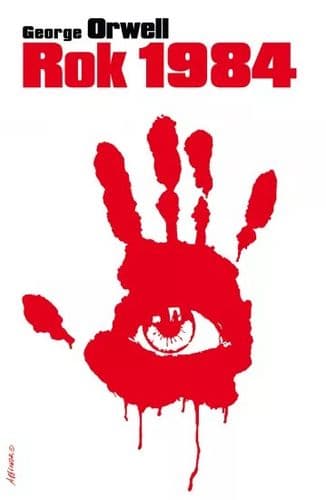 Cover of the book "Nineteen Eighty-Four"
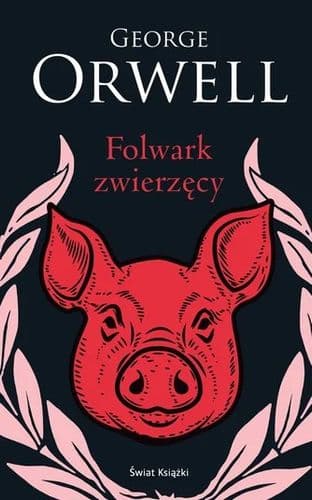 Cover of the book "Animal Farm"
In 1944, he and his wife adopted Richard Horatio, born on May 14th, and after her death on March 29th, 1945, he returned to England. His works reflect his intelligence, wit, and sensitivity to social inequality. He was often considered the best chronicler of 20th-century English culture, and most importantly, he was a staunch critic of totalitarian systems and a proponent of democratic socialism. His best-known works include the futuristic, dystopian novel Nineteen Eighty-Four and the satirical tale allegorizing the totalitarian system, Animal Farm.
Both of these books made Orwell one of the most popular writers of the 20th century. During the Polish People's Republic, Orwell's works were banned. Until the fall of communism, Nineteen Eighty-Four was available in Polish translation only in exile. George Orwell died of tuberculosis on January 21st, 1950, in London, at the age of forty-seven. 76 years have passed since his death and it turns out that his futuristic visions of the future and totalitarian rule are being implemented with great care in modern times.
 Maidan was a major logistical operationHistorical sources clearly indicate that the months-long protest on Maidan was a major logistical operation. During the Orange Revolution at the turn of 2004 and 2005, civilian tents, purchased from ordinary shops, predominated. However, in December 2013, as archival photos show, they were a distinct minority. The construction of the barricades also demonstrated the high level of professionalism of the protesters and the relatively extensive resources at their disposal. Almost all of the materials used for their construction were imported from outside Maidan.
 Maidan - wood, sand and several tons of free food dailyMoreover, maintaining the permanent Maidan staff, largely recruited from outside Kyiv, required the daily delivery of several tons of free food and beverages. Demonstrations took place not only in Kyiv but also in other cities in western Ukraine, attracting tens of thousands of people in Lviv and several thousand each in Ternopil and Ivano-Frankivsk.
 Communication center on Maidan, professional stage and television broadcastsThe stage where opposition politicians were performing was repeatedly shown on television. A professional logistics company had to provide it. The stage and its backstage area served as a communication hub for the protesters.
The Ukrainian newspaper "Day of Zaporizhzhia," based on information from a source in the Security Service of Ukraine (SBU), wrote that:
[...] Aid for Euromaidan amounts to approximately $20 million per week. This money was transferred directly to the headquarters of the opposition parties – Svoboda and Batkivshchyna – and then distributed to support Euromaidan. This was evidenced by the results of a search conducted by the SBU at the headquarters of Batkivshchyna's central headquarters. $17 million in cash was reportedly found in Alexander Turchynov's office.
-272x286.jpg&w=640&q=75) Yuri Vitalyovych Lutsenko (born 1964)One of the organizers of the Maidan rally was Yuri Lutsenko's Third Republic Movement, previously an organizer of the Orange Revolution, former Interior Minister in Yulia Tymoshenko's government, and advisor to President Yushchenko. Lutsenko was arrested in late December 2010 and sentenced to four years in prison in February 2012 for embezzlement of public funds. At the time, he was considered a political prisoner by his associates. Due to pressure from the EU, he was pardoned by President Yanukovych in April 2013. Ideologically, Svoboda and Right Sector triumphed at the Maidan rally.
Yuri Vitalyovych Lutsenko (born 1964)One of the organizers of the Maidan rally was Yuri Lutsenko's Third Republic Movement, previously an organizer of the Orange Revolution, former Interior Minister in Yulia Tymoshenko's government, and advisor to President Yushchenko. Lutsenko was arrested in late December 2010 and sentenced to four years in prison in February 2012 for embezzlement of public funds. At the time, he was considered a political prisoner by his associates. Due to pressure from the EU, he was pardoned by President Yanukovych in April 2013. Ideologically, Svoboda and Right Sector triumphed at the Maidan rally.
 Symbol of the Organization of Ukrainian NationalistsAs Polish analysts from a government research center emphasized in a study from that period:
[...] the UPA does not appear on Maidan as a criminal organization, or even an ideological one, but as a heroic army of immortals fighting for Ukraine's independence. The red and black banner of the OUN quickly became a national symbol (as distinct from state symbols), as did the greetings "Glory to Ukraine! Glory to the heroes!", derived from UPA tradition and slightly modified in their content.
-423x500.jpg&w=1080&q=75) Andriy Volodymyrovych Parubiy (born 1971)One of the Commanders of Maidan and the commander of the self-defense forces was Andriy Parubiy, a member of parliament from Batkivshchyna, and a former radical, one of the founders of the Social-Nationalist Party of Ukraine, whose program was close to national socialism (later Svoboda emerged from this party).
Andriy Volodymyrovych Parubiy (born 1971)One of the Commanders of Maidan and the commander of the self-defense forces was Andriy Parubiy, a member of parliament from Batkivshchyna, and a former radical, one of the founders of the Social-Nationalist Party of Ukraine, whose program was close to national socialism (later Svoboda emerged from this party).
-350x492.jpg&w=750&q=75) Petro Oleksiyovych Poroshenko (born 1965)The protesters were actively supported by, among others, the oligarch Petro Poroshenko, linked to Yushchenko, who controls the news channel Channel 5 and owns the Ukrprominvest concern, which operates in the automotive and food industries (assets valued at $1.6 billion). At a certain point during EuroMaidan, pro-EU slogans were replaced by anti-government ones. The so-called Maidan began expanding its infrastructure. A tent city was established, protected by barricades and efficient, numerous self-defense units (maximum around 4,000 men), whose main fighting force consisted of Cossacks, members of the Ukrainian Association of Afghan Veterans, as well as the nationalist Svoboda party and the – until then marginal – Right Sector.
Petro Oleksiyovych Poroshenko (born 1965)The protesters were actively supported by, among others, the oligarch Petro Poroshenko, linked to Yushchenko, who controls the news channel Channel 5 and owns the Ukrprominvest concern, which operates in the automotive and food industries (assets valued at $1.6 billion). At a certain point during EuroMaidan, pro-EU slogans were replaced by anti-government ones. The so-called Maidan began expanding its infrastructure. A tent city was established, protected by barricades and efficient, numerous self-defense units (maximum around 4,000 men), whose main fighting force consisted of Cossacks, members of the Ukrainian Association of Afghan Veterans, as well as the nationalist Svoboda party and the – until then marginal – Right Sector.
-407x500.jpg&w=828&q=75) Victoria Nuland (born 1961)
Victoria Nuland (born 1961)-331x386.jpg&w=750&q=75) Geoffrey Ross Pyatt (born 1963)
Geoffrey Ross Pyatt (born 1963)
The United States' involvement in Ukraine's internal affairs is evidenced by a leaked conversation between U.S. Deputy Secretary of State Victoria Nuland and U.S. Ambassador to Ukraine Geoffrey Pyatt. In the conversation, Victoria refers to the EU in a rather unparliamentary manner, saying, "Fuck the EU." The interlocutors discuss Ukrainian opposition leaders and their role in the crisis in Ukraine, the UN, and the European Union. Nuland stated, among other things, that the Americans considered Yatsenyuk the most suitable candidate, as he was, after all, a minister in Tymoshenko's government. The U.S. State Department confirmed the authenticity of the recording. The fact that Arseniy Yatsenyuk ultimately became prime minister is no coincidence.
Regarding the rebels' weaponry, we read:
[...] The rebels in Kyiv's Maidan square commonly used handguns. One Polish television program showed a demonstrator repeatedly firing a pistol from his belt at a photo of President Viktor Yanukovych, in response to a question about his fate after his capture.
According to available data, Kyiv residents alone owned 200,000 firearms.
 Barricade on Instytutska Street at the foot of the October PalaceRegarding the equipment and numbers of the Maidan self-defense forces, we read:
[...] The self-defense forces proved to be a match for the militia and internal troops, demonstrating considerable training and leadership. The rebels possessed helmets, hard hats, respiratory protection against CS/CN, shields, batons, equipment seized from law enforcement forces, tactical and bulletproof vests, and gasoline bottles. The barricades constructed around Maidan in some places reached 3-4 meters in height and were surrounded by barbed wire fences.
The permanent Maidan garrison at the time ranged from 6,000 to 10,000 people. Dealing with them would have required the deployment of heavy equipment and the readiness to use firearms on a large scale. In the second phase of the clashes, some protesters were equipped similarly to the security forces. According to self-defense representatives, on February 22nd, the formations occupying government buildings alone consisted of over 40 sotnias, or approximately 4,000 people.
 Bulldozer Attack on Security ForcesThe involvement of the Organization of Ukrainian Nationalists is confirmed by events during the Maidan riots:
[...] At one point during Maidan, students were pacified, and a day later, several hundred thousand demonstrators took to the streets of Kyiv. However, the media only showed a group of approximately 200 people armed with bats, Molotov cocktails, and stones, supported by a bulldozer, attacking the cordon of police and internal troops protecting the presidential administration building on Bankova Street.
To control the situation, Berkut, a specialized unit of the Ukrainian militia subordinate to the Ministry of Internal Affairs, launched a counterattack, and only mediation brought an end to the fighting.
[...] Initially, official propaganda spoke of provocateurs paid by the authorities, the so-called titushki, but it quickly became clear that the Right Sector militia, an extreme nationalist organization drawing on the traditions of the OUN/UPA, was behind the fighting. The attention of more attentive observers was drawn to the fact that the demonstration was protected by a formation equipped with uniform red helmets and batons, whose members had their faces covered.
 Jarosław Kaczyński at Maidan, December 2013Polish authorities, pursuing a neo-Promethean policy, also "inveigled" into Ukrainian affairs.
To clarify: the neo-Promethean idea is a continuation of the Promethean idea initiated by Józef Piłsudski. It is a utopian political and ideological concept seeking to liberate nations dominated by Russia and restore their independence.
According to the former head of the SBU (Security Service of Ukraine), camps existed in western Ukraine where future Maidan fighters were trained. When the then-government tried to "squeeze" these camps, volunteers left for Poland and Lithuania.
Unofficial sources claim that radical Ukrainians were being trained in Poland (including in Legionowo). Polish secret services, primarily civilian ones, were allegedly behind this. When Russian President Vladimir Putin spoke about this matter during a press conference, Polish officials denied his statement, calling it completely baseless.
 Jarosław Kaczyński gives the first speech at Maidan, December 2013Polish politicians of all stripes participated in the Maidan marches, where they openly called for the overthrow of the legally elected Ukrainian government. Among them was the leader of the Law and Justice party, Jarosław Kaczyński, who spoke alongside the leader of the anti-Polish and anti-Semitic Svoboda party, Oleh Tyahnybok, a Banderite who demanded, among other things, the separation of 19 southeastern Polish counties. Kaczyński spoke against a backdrop of Banderite black and red flags and shouted fascist chants of "Glory to Ukraine!"
-417x500.jpg&w=1080&q=75) Janusz Piechociński (born 1960)One of the few who realistically assessed Polish policy towards Ukraine was Deputy Prime Minister and Minister of Economy Janusz Piechociński.
Janusz Piechociński (born 1960)One of the few who realistically assessed Polish policy towards Ukraine was Deputy Prime Minister and Minister of Economy Janusz Piechociński.
In early April 2014, Piechociński said:
[...] Above all, we must remember that we are in the European Union. Our response to the events in Ukraine should therefore be implemented through European structures. Piechociński added: "Let us remember that Ukraine – despite our unequivocal support – was one of the first to impose an embargo on Polish pork. The price for Polish activity in Ukraine could be a loss of several hundred million złoty. Russia is our second largest export partner."
-414x500.jpg&w=828&q=75) Bronisław Komorowski (born 1952)Shortly after the situation in Kyiv's Maidan Square calmed down, a briefing of senior staff from the Ministry of National Defense and the Polish Armed Forces took place at the end of March 2014.
Bronisław Komorowski (born 1952)Shortly after the situation in Kyiv's Maidan Square calmed down, a briefing of senior staff from the Ministry of National Defense and the Polish Armed Forces took place at the end of March 2014.
[...] To the surprise of the audience, President Bronisław Komorowski gave them an example of Russia properly caring for its security, adding [...] The most important task today is to focus on improving the quality of the Polish Armed Forces.
In the context of President Komorowski's speech, it is worth noting that one of the largest Polish modernization projects in recent years was the purchase of over two hundred old, former German Leopard tanks, without any guarantee that Polish companies would modernize them. Deputy Minister Waldemar Skrzypczak, who was behind these purchases, resigned shortly after ordering the second batch of Leopard tanks due to suspicions of manipulating purchases for the Ministry of National Defense.
-289x392.jpg&w=640&q=75) George Orwell (Eric Blair)In one article on Polish media coverage from the post-2014 period, we read:
George Orwell (Eric Blair)In one article on Polish media coverage from the post-2014 period, we read:
[...] The Polish media's attitude toward public communication is comparable to George Orwell's dystopia from 1984. In Orwell's novel, the world is divided into three superpowers, which – freely shifting coalitions – constantly fight each other to maintain internal tension and, as a result, ensure peace and submission among their own citizens. For them, hate ceremonies are organized against a symbolic enemy, remarkably reminiscent of the crude attacks by Polish politicians and journalists on Russian President Vladimir Putin.
The author of the article stated that:
[...] Propaganda, falsification of information, and total surveillance are everyday literary reality, which is now beginning to come true. This has nothing to do with the real threats to Poland's security and interests, including from the East.
General comments regarding the foreign policy pursued in the Polish "Muppet Show":
1. Ukraine, in addition to Russia, borders Belarus, Poland, Slovakia, Hungary, and Romania.
2. Of the countries mentioned, only Polish politicians actively participated in destabilizing the situation in Kyiv, calling for the overthrow of the local authorities.
3. Polish politicians' speeches in Ukraine were always accompanied by black-and-red Bandera flags, and our supposed representatives shouted "Glory to Ukraine!", thus paying homage to the fascist cult of Bandera in that country.
Well, I leave the final assessment of the policies pursued by the "representatives" of our small empire to individual judgment, but I often wonder, "like Orwell," whether they haven't mistaken the country they are supposed to serve.
-470x441.jpg&w=1080&q=75) Viktor Orban (born 1963)By way of contrast, I'll mention a politician who could be an "icon" for the country's rulers. This person is Hungarian Prime Minister Viktor Orbán, who in early March 2014 spoke out on Hungary's policy towards Ukraine. This policy can be summarized in three points:
Viktor Orban (born 1963)By way of contrast, I'll mention a politician who could be an "icon" for the country's rulers. This person is Hungarian Prime Minister Viktor Orbán, who in early March 2014 spoke out on Hungary's policy towards Ukraine. This policy can be summarized in three points:
1. To the surprise of the one-sided Polish media, the politician stated that his country does not intend to interfere in the Russia-Ukraine conflict. Hungary is not part of this conflict.
2. Hungarians are safe in Hungary and are also safe in the Ukrainian region of Transcarpathia.
3. The Hungarian government is working to keep it that way, Viktor Orbán said.
Short and to the point!!!
[...] At the end of March of the same year, Orbán stated that it would be best to avoid economic sanctions against Russia, as this is not in the interest of Europe, and Hungary in particular. He also added that the crisis related to the situation in Crimea had not affected plans to expand the Hungarian nuclear power plant in Paks, where two new power units are to be built. The Russian Federation is to grant Hungary a loan of up to €10 billion for the expansion of the plant. The plant is intended to provide Hungary with affordable energy.
The example of Hungarian President Viktor Orbán demonstrates that protecting the interests of one's nation and the sovereignty of the state are paramount, and cannot be replaced by utopian fantasies of brotherhood and cooperation with a supposed ally, or by uncritically following the orders of foreign "Kermit" states.
This concludes Episode 18, "The Meddling Government," in which I presented the facts from the events at Maidan and the interference of "our" government in events in Ukraine. I cordially invite you to read Episode 19, "The Mirage of Power."
Photo source: Wikipedia