 PL
PL EN
EN#22Steppe Wind
Murders of Poles, the Khmelnytsky Uprising, Koliyivshchyna, the massacre in Uman.
-465x449.jpg&w=1080&q=75) Henryk Sienkiewicz (1846-1916)Henryk Sienkiewicz was born 180 years ago, on May 5, 1846, in Wola Okrzejska. The village of Wola Okrzejska still exists in Poland today, in the Lublin Voivodeship, Łuków County, in the Krzywda Commune. However, the name of the commune had little to do with Henryk, as he was born into an impoverished but nonetheless noble family. The Sienkiewicz family had their own coat of arms, Oszyk, which featured a swan, a bow with arrows, and an anchor. According to genealogists, families bearing this coat of arms were known as early as the 16th century in Samogitia (a region in Lithuania), and some claim that the ancestors were Tatars from Lithuania. Henryk's father was Józef Sienkiewicz, and his mother was Stefania Sienkiewicz, née Cieciszowska, from an old and wealthy Podlasie family. Henryk had an older brother, Kazimierz, and four sisters: Aniela, Helena, Zofia, and Maria, who died early. It turns out that Wola Okrzejska belonged to Henryk's grandmother, Felicjana Cieciszowska.
Henryk Sienkiewicz (1846-1916)Henryk Sienkiewicz was born 180 years ago, on May 5, 1846, in Wola Okrzejska. The village of Wola Okrzejska still exists in Poland today, in the Lublin Voivodeship, Łuków County, in the Krzywda Commune. However, the name of the commune had little to do with Henryk, as he was born into an impoverished but nonetheless noble family. The Sienkiewicz family had their own coat of arms, Oszyk, which featured a swan, a bow with arrows, and an anchor. According to genealogists, families bearing this coat of arms were known as early as the 16th century in Samogitia (a region in Lithuania), and some claim that the ancestors were Tatars from Lithuania. Henryk's father was Józef Sienkiewicz, and his mother was Stefania Sienkiewicz, née Cieciszowska, from an old and wealthy Podlasie family. Henryk had an older brother, Kazimierz, and four sisters: Aniela, Helena, Zofia, and Maria, who died early. It turns out that Wola Okrzejska belonged to Henryk's grandmother, Felicjana Cieciszowska.
Henryk attended Warsaw schools, but he wasn't a top student and excelled in humanities. At his parents' urging, he unsuccessfully attempted to study law and medicine. Ultimately, he managed to gain admission to the Faculty of Philology and History, where he failed the Greek exam and left without a degree. Henryk's only benefit from his latter studies was acquiring a thorough knowledge of Old Polish literature and language.
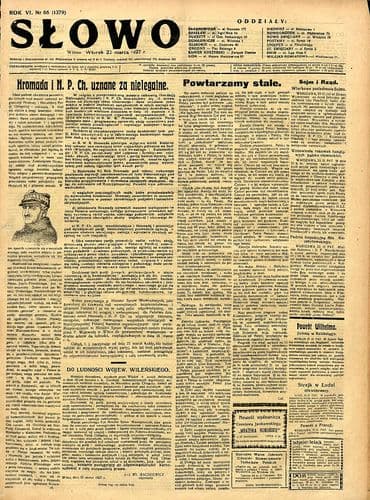 Title page of the Vilnius daily "Słowo" from March 22, 1927, editor-in-chief Stanisław MackiewiczSoon Sienkiewicz turned to journalism and wrote his first novel with the intriguing title "Na marne" (In Vain). Despite the rather unsatisfactory title of his first novel, Henryk's writing career began to flourish and he wrote four more novels, the last three of which are called a small trilogy. Sienkiewicz quickly became popular in Warsaw salons and in 1876 he traveled to the United States, where he wrote his next works. After two years, he returned to Europe, first to London, then Paris, Venice, and Lviv, writing further works and collaborating with the Polish daily "Słowo."
-275x500.jpg&w=640&q=75) Maria Szetkiewicz (1854-1885)
Maria Szetkiewicz (1854-1885)-350x500.jpg&w=750&q=75) Maria Babska (1864-1925)
Maria Babska (1864-1925)
Henryk was married three times, and interestingly, all his wives were named Maria (like his deceased sister). His first wife was Maria Szetkiewicz, whom he married on August 18, 1881. Unfortunately, his happiness was short-lived, as four years later, at the age of 31, Maria died of tuberculosis. This marriage produced a son, Henryk, and a daughter, Jadwiga. His next wife, Maria Wołodkiewicz, was likely the adoptive daughter of a wealthy Odessa man. The wedding took place in 1893, but after just a month, the bride fled. Henryk didn't give up and diligently continued his search for another Maria. Only after 11 years did he find Maria, now surnamed Babska. A bit unfortunate, this third Maria turned out to be closely related to Henryk, as she was his first cousin. Well, life doesn't have to be perfect, and besides, she was Maria too.
-318x500.jpg&w=640&q=75) Historical novel With Fire and Sword (written 1884–1888)In 1880, Sienkiewicz wrote the historical novel "Tatar Captivity" and worked on the historical novel "With Fire and Sword." He initially titled the novel "Wilcze Nest" (a name similar to "Wilcze Echoes"), but ultimately the name "With Fire and Sword" prevailed. This novel initiated the subsequent parts of the Trilogy, which brought the writer great popularity and were met with extraordinary public reception. The novel's action takes place between 1648 and 1651, during the Khmelnytsky Uprising in Ukraine. The author occasionally departs from historical truth, which does not detract from the work's literary value. I will discuss the Khmelnytsky Uprising, among other things, in this article.
Historical novel With Fire and Sword (written 1884–1888)In 1880, Sienkiewicz wrote the historical novel "Tatar Captivity" and worked on the historical novel "With Fire and Sword." He initially titled the novel "Wilcze Nest" (a name similar to "Wilcze Echoes"), but ultimately the name "With Fire and Sword" prevailed. This novel initiated the subsequent parts of the Trilogy, which brought the writer great popularity and were met with extraordinary public reception. The novel's action takes place between 1648 and 1651, during the Khmelnytsky Uprising in Ukraine. The author occasionally departs from historical truth, which does not detract from the work's literary value. I will discuss the Khmelnytsky Uprising, among other things, in this article.
-500x361.jpg&w=1080&q=75) Khmelnytsky Uprising (1648-1658)Our Polish history clearly demonstrates a vast number of conflicts between Poles and Ukrainians, not only in the 20th century, but also earlier, with their ancestors, the Cossacks and Ruthenians. The historical evidence regarding manifestations of hostility between Ukrainians and their ancestors towards Poles is extensive, so I will limit myself to just three historical facts. These facts confirm the hostility towards Poles among the people who inhabited the territories of modern-day Ukraine in the past. In this article, I will discuss only two historical events.
Khmelnytsky Uprising (1648-1658)Our Polish history clearly demonstrates a vast number of conflicts between Poles and Ukrainians, not only in the 20th century, but also earlier, with their ancestors, the Cossacks and Ruthenians. The historical evidence regarding manifestations of hostility between Ukrainians and their ancestors towards Poles is extensive, so I will limit myself to just three historical facts. These facts confirm the hostility towards Poles among the people who inhabited the territories of modern-day Ukraine in the past. In this article, I will discuss only two historical events.
Example 1. The Khmelnytsky Uprising 1648–1658.
Let's go back in time 378 years to 1648, when the Zaporozhian Cossacks and Ruthenian peasantry, led by Cossack Hetman Bohdan Khmelnytsky, broke out against the Polish-Lithuanian Commonwealth.
A few words about Ruthenian society at that time:
[...] Ruthenian society was highly diverse. The peasantry, or the Blacks, were at the lowest echelon. This was a heterogeneous class, composed primarily of locals and partially of Russified peasants. A purely Ruthenian burgher class was practically nonexistent – the cities were inhabited primarily by Armenian merchants and Jews, as well as Poles. Cossacks aspired to the role of elite, and among them, there were also visible divisions: registered Cossacks were in the pay of the Polish-Lithuanian Commonwealth and often held nobility.
-336x447.jpg&w=750&q=75) Bohdan Zenobi Khmelnytsky (1595-1657)Here are selected historical facts about the Khmelnytsky Uprising.
Bohdan Zenobi Khmelnytsky (1595-1657)Here are selected historical facts about the Khmelnytsky Uprising.
The Khmelnytsky Conspiracy and Imprisonment.
[...] In September 1647, Khmelnytsky formed a conspiracy of Cossack elders dissatisfied with the situation in the region. The conspiracy was uncovered as a result of a denunciation. [...] Khmelnytsky was arrested and imprisoned in Kryłów. However, the denunciations were insufficient to secure a conviction, and Khmelnytsky was released on bail.
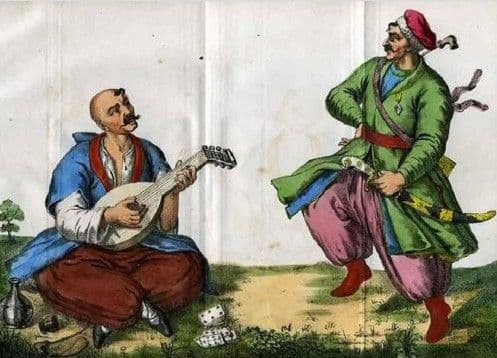 Zaporozhian Cossack[...] When the future hetman regained his freedom, he immediately began preparations for an escape to the Sich. On December 11 (1647), he arrived at the Sich accompanied by approximately 200 conspirators and approximately 300 local fishermen and hunters and immediately began agitation to overturn the restrictive laws of 1638. On February 4, Khmelnytsky finally persuaded the Zaporozhian Cossacks to participate in the conspiracy.
The first armed clashes between Khmelnytsky's Cossacks and the Poles.
[...] From February 5–9 (1648), minor skirmishes took place between the insurgents and the forces of Colonels Wadowski and Krzeczowski. Khmelnytsky tried, unsuccessfully, to persuade the Cossacks serving under Polish command to defect to his side. [...] After the fighting ended, Khmelnytsky decided to change his tactics and sent his spies throughout Ukraine, agitating among the local population for an uprising.
Unable to defeat the Poles, Khmelnytsky decided to find an ally abroad. To this end, he stole royal letters, which he used to convince the Tatar khan of the alleged threat of a Polish invasion.
[...] In mid-March 1648, a Cossack-Tatar alliance against the Polish-Lithuanian Commonwealth was signed in Bakhchisarai. It was agreed that the Tatars would receive plunder of men and animals, while the Cossacks would receive jewelry, gold, and clothing.
-500x432.jpg&w=1080&q=75) Battle of Zhovti Vody 1648 (defeat of the Polish-Lithuanian Commonwealth forces due to Khmelnytsky's betrayal)Already during the negotiations for an alliance with the Tatars, Khmelnytsky began diplomatic action aimed at lulling Hetman Mikołaj Potocki into a state of alert.
Battle of Zhovti Vody 1648 (defeat of the Polish-Lithuanian Commonwealth forces due to Khmelnytsky's betrayal)Already during the negotiations for an alliance with the Tatars, Khmelnytsky began diplomatic action aimed at lulling Hetman Mikołaj Potocki into a state of alert.
I will not describe the subsequent course of the uprising, which lasted until 1657, but it is a fact that thousands of Polish nobles perished in the uprising instigated by Khmelnytsky, a traitor to the Polish-Lithuanian Commonwealth, often subjected to cruel torture and brutal murder.
As history indicates, Khmelnytsky's uprising was not the first Cossack armed uprising against the Polish-Lithuanian Commonwealth. It was preceded by numerous earlier rebellions and rebellions, including those led by Kosiński, Nalewajko, and Pawluk.
-500x290.jpg&w=1080&q=75) Bar Confederation (1768–1772)Example 2. The Bar Confederation, 1768-1772.
Bar Confederation (1768–1772)Example 2. The Bar Confederation, 1768-1772.
The Bar Confederation was an armed union of Polish nobility, formed in Bar, Podolia, on February 29, 1768, with the swearing of a founding act in defense of the Catholic faith and the independence of the Polish-Lithuanian Commonwealth.
[...] The Confederation was directed against the protectorate of the Russian Empire, King Stanisław August Poniatowski, and the Russian troops supporting him. The Confederation's goal was to abolish laws imposed by Russia, especially those granting equal rights to non-Russian believers.
-359x361.jpg&w=750&q=75) Stanisław August Poniatowski (1732-1798)The Confederates, initiating a civil war, also declared war on Russia and attacked Russian garrisons stationed in the Polish-Lithuanian Commonwealth since the interregnum in 1763. When the Russians, supported by Crown forces loyal to Stanisław August, under the command of regiment leader Franciszek Ksawery Branicki, captured Bar on June 19, 1768, the nobility moved the fighting to Ukraine, hoping for assistance from nearby Turkey.
Stanisław August Poniatowski (1732-1798)The Confederates, initiating a civil war, also declared war on Russia and attacked Russian garrisons stationed in the Polish-Lithuanian Commonwealth since the interregnum in 1763. When the Russians, supported by Crown forces loyal to Stanisław August, under the command of regiment leader Franciszek Ksawery Branicki, captured Bar on June 19, 1768, the nobility moved the fighting to Ukraine, hoping for assistance from nearby Turkey.
-188x239.jpg&w=384&q=75) Maksym Żeleźniak (1740-1768)
Maksym Żeleźniak (1740-1768)-260x335.jpg&w=640&q=75) Iwan Gonta (1705-1768)
Iwan Gonta (1705-1768)
In Ukraine, a haidamak rebellion and massacres of Polish and Jewish people took place. The peasant uprising known as Koliyivshchyna, led by Maksym Zheleznyak and Ivan Gonta, was directed primarily against the Polish nobility, the Jewish population, and the clergy. The Koliyivshchyna lasted from June to July 1768 in Right-Bank Ukraine and was characterized by mass murders of Poles, Jews, and Roman Catholic and Uniate clergy. The largest pogrom was the Uman Massacre. The number of victims of Koliyivshchyna is estimated at between 100,000 and 200,000.
The Uman Massacre.
[...] The Uman Massacre was committed by Cossacks and Russian peasants during their Koliyivshchyna rebellion on June 20 and 21, 1768. The victims were mostly Poles and Jews who had taken refuge in Uman. Among the victims were many women and children. The total number of Poles and Jews killed was estimated at approximately 20,000. The Uman Massacre was a tremendous shock to the Poles primarily because it was perpetrated by peasants and the atrocities committed during it, rather than because of the number of people killed.
-388x500.jpg&w=828&q=75) Franciszek Salezy Potocki of the Pilawa coat of arms (1700-1772)
Franciszek Salezy Potocki of the Pilawa coat of arms (1700-1772)
The causes of the massacre in Uman.
[...] The governor and defender of Uman, who belonged to the Kiev voivode Franciszek Salezy Potocki, was Rafał Mładanowicz, who led 2,500 armed soldiers. Among them was Ivan Gonta, a Cossack centurion (commander of Potocki's court militia), who was sent as a mediator against the rebellious peasants approaching the city.
Gonta betrayed Potocki and joined with the rebels, who, after a fierce assault lasting several hours, captured the city on June 20th.
[...] Crowds of insurgents broke into the city [...] Most of the nobility and Jews gathered in churches, the synagogue, and the town hall. Catholic priests communed and granted absolution [...] the massacre began, most likely initiated by peasants eager for revenge.
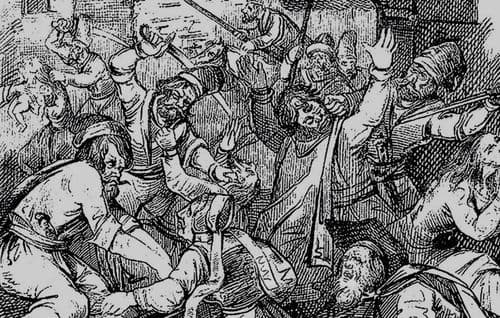 The Uman MassacreAccording to contemporary accounts, approximately three thousand Jews were killed in the synagogue alone.
[...] They were killed and tortured. Jews had their hands and ears cut off. They were also dragged from basements, houses, and even ditches where they had sought refuge in vain. Catholic and Uniate priests became the next victims of the insurgent mob's hatred. In Uman, among the murdered Uniate clergy were monks from the local Basilian monastery.
After the bloody massacre, the traitor Ivan Gonta declared himself Prince of Uman, and Maxim Zhelizniak, the main leader of Koliyivshchyna, Prince of Smily and Cossack Hetman. Ultimately, the uprising was crushed by Russian and Polish forces, and its leaders, Gonta and Zhelizniak, were executed.
 Monument to Maksym Zheleznyak and Ivan Gonta, Ukraine todaySome historical facts about Maksym Zheleznyak.
[...] He was born around 1740, the son of a peasant. At the age of 13, he fled to Zaporizhzhia and became a Zaporizhian Cossack. Illiterate, he worked as a fisherman, and in 1767 became a monastery servant. In 1768, he became one of the leaders of the Koliyivshchyna, or haidamak uprising in Right-Bank Ukraine.
Official sources state that the Cossack leaders Ivan Gonta and Maksym Zheleznyak were executed, while other unofficial versions offer a completely different account of Zheleznyak's fate.
[...] After being captured by Russian troops, as a Russian subject, he was most likely sentenced to hard labor and deported to Nerchinsk, Siberia, where he died.
According to some historians, Zheleznyak escaped from exile but was captured. There is also a version that he escaped and took part in Yemelyan Pugachev's uprising between 1773 and 1775. In any case, Zheleznyak is one of the main characters in Taras Shevchenko's poem "Haidamaky" (1841), which describes the cruelty of the murders committed against Poles and Jews by the haidamaks, who were made up of escaped Ukrainian peasants, impoverished townspeople, and Zaporozhian Cossacks.
 Monument to Ivan Gonta, Ukraine todayIn late 2009, during the broadcast of the popular science series "History of Ukrainian Lands," sponsored by the Lviv Brewery, the phrase "Lach, Jew, and sobaka, alle vir odnaka" appeared on Ukrainian television. This phrase was used by Russian peasants and haidamaks during the gallows hanging of Poles and Jews, alongside whom a dog was also hung on a common beam to dishonor the corpses. The scandal arose from an episode of the series devoted to the Uman Massacre, which encouraged people to learn about the supposedly "glorious past of the homeland." In this episode, after conquering the city, Ataman Zheleznyak, while drinking "Lwowskie" beer, hanged "Lach, Jew, and dog – because their faith is the same" from the church tower. Polish borderland groups expressed outrage, and PiS MP Stanisław Pięta called for a boycott of beers produced by the Carlsberg Group (which owns the Lviv Brewery) and demanded a swift and decisive apology.
In Ukraine, Ivan Gonta is held in high esteem. A street named after him exists in Lviv, and a monument to him was erected in Khrystynivka. During the unveiling of the Ivan Gonta monument (attended by local government representatives and bishops of the Ukrainian Orthodox Church of the Kyivan Patriarchate), the city's mayor (president), Mykola Nakonieczny, emphasized that the Gonta monument would remind Ukrainians to fight for their homeland against its oppressors.
This concludes episode 22, in which I presented two historical facts confirming the hostile attitude towards Poles of the ancestors of contemporary Ukrainians, Rusyn peasants, and Zaporozhian Cossacks. I cordially invite you to the next episode, Episode 23, titled Brave Eaglets.
Photo source: Wikipedia