 PL
PL EN
EN#12False Idol
How Did Stepan Bandera become a Martyr and a Hero in Ukraine?
 Ehrentempel, the Temple of Honor in Munich, completed in 1935Martyrdom is an expression of unconditional attachment to ideas and beliefs, and therefore has enormous significance in perpetuating attitudes and patterns, especially religious ones. The concept of martyrdom for the faith exists in Christianity, Judaism, and Islam. In Christianity, this term refers to someone who was killed by a persecutor for their faith in Jesus Christ.
In the Third Reich, the authorities promoted a state cult of victims of the Munich Putsch, such as Herbert Norkus, Horst Wessel, and Wilhelm Gustloff. These were the so-called blood witnesses, and monuments and even buildings of a cult nature were erected in their honor (such as the Ehrentempel in Munich, destroyed by the Allies in 1947).
It is astonishing that Stepan Bandera, a criminal who adhered to the ideology of the Ukrainian nationalists of the OUN, was responsible, among other things, for the murder of a Polish citizen. for the genocidal murders of Poles in Volhynia and Eastern Galicia, suddenly became a martyr and hero of Ukraine in October 1959. How did this happen and who was responsible?
 Bandera's funeral in Munich, October 20, 1959On October 15, 1959, Stepan Bandera was killed, as the newspapers reported, by enemy forces. This event can be viewed from several perspectives. Let's try to analyze this fact briefly, limiting ourselves to just two questions:
Question 1. Who would benefit most from Bandera's assassination?
The answer may be surprising, but after some reflection, I have concluded that the Ukrainian nationalists, or rather the OUN, would benefit most. So let's ask another question:
Question 2. What significance did Bandera's death have for Poles and Russians? I will propose three answers.
a. Positive - the criminal is dead.
b. Negative - he was not brought to trial, tried, and convicted.
c. Very negative - according to the OUN, every killed member automatically becomes a martyr and hero.
Which answer do you think was true? Here is an answer (c) to question 2:
 Stepan Bandera's funeral, Great Britain 1959Bandera's assassination transformed him into a martyr and strengthened his myth and political cult. Immediately after the assassination, segments of the Ukrainian diaspora portrayed his death as the greatest catastrophe in Ukrainian history. The Ukrainian diaspora organized a vast number of deeply politicized and ritualistic mourning ceremonies, lasting for weeks. In this way, the diaspora community revived the cult of Providnyk (leader) and became a charismatic community.
 Recruiting center for the Waffen-SS Galizien, April 28, 1943After his death, Bandera was commemorated in many countries, including Argentina, Australia, Belgium, Brazil, Great Britain, Canada, France, the United States, and Venezuela. The global cult of Bandera would not have been possible without the sponsorship of Ukrainian emigrants in the late 1940s and early 1950s. The most enthusiastic émigré element promoting Bandera worship consisted of those Ukrainians who left Ukraine in 1944 with the retreating German Army and veterans of the Waffen-SS Galicia who surrendered to the British Army.
 Article from the Munich newspaper Victory Road, October 18, 1959The Munich newspaper Victory Road (Munich Shliakh Peremohy), controlled by the OUN, where Bandera officially worked as a journalist, published a massive obituary on its front page on October 18, 1959, with Bandera's photograph in the center. Although it was unknown who killed Bandera, the editors wrote in large letters above the portrait:
[...] On October 15, 1959, STEPAN BANDERA, the Great Son of the Holy Ukrainian Nation and long-time leader of the revolutionary struggle for the state and independence of Ukraine, Head of the Directorate of Foreign Units of the Organization of Ukrainian Nationalists, was killed by enemy forces.
Two historical facts were also presented, one of which was the truth, that he was sentenced to death by a Polish court, which was commuted to life imprisonment, and the other was a lie, that he was a prisoner in German prisons and concentration camps from 1941 to 1944 (as we know, Bandera spent less than a year in Sachsenhausen in comfortable conditions). The mourning for Bandera was to last two months, from October 15 to December 15, 1959.
 Ukrainian children commemorate Bandera in a symbolic coffin, Galashiels, Scotland, 1960sOther nationalist newspapers published in the Ukrainian diaspora, such as Toronto's Homin Ukraїny and London's Dumka Ukraїnska, responded to Bandera's death in a similar manner. They published articles titled "Warrior, Leader, and Symbol" and "In the Depths of Sorrow."
On October 22nd, just a week after Bandera's death, London's Ukrayinska Dumka published not an obituary but a photograph with a bust of Bandera and a long, tearful article beginning with the words:
[...] Stepan Bandera is dead! Stepan Bandera was killed by enemy hands.
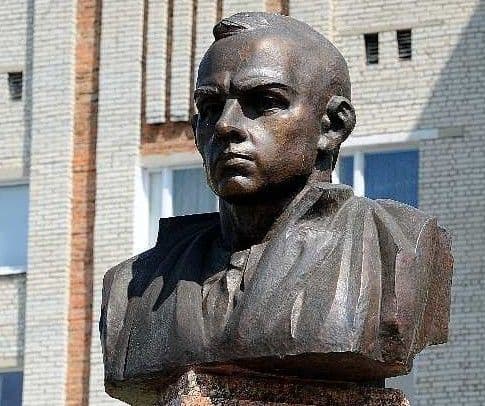 Bust of Stepan BanderaThe question of the Bandera bust is puzzling: who made it and when?
It turns out that the Bandera bust, and even the two Providnyk busts, were prepared much earlier, as early as 1948 in Bavaria, one made of plaster and the other of wood. It appears that either the OUN propaganda apparatus had anticipated the possibility of Bandera's death, or his death was planned by them.
The busts were made by Mykhailo Chereshnovskyi, a Ukrainian UPA partisan who came from Ukraine to Bavaria in 1947. The busts depicted Bandera in the early 1940s, when the OUN-B was carrying out the "Ukrainian National Revolution," meaning the genocide in Volhynia.
 Stepan Bandera's death mask at the London MuseumIn an article about the death of Stepan Bandera, it was stated that October 15th should remain a day of mourning forever, similar to the anniversaries of the deaths of Symon Petliura, Yevhen Konovalets, and Roman Shukhevych. It also argued that Bandera's death was a time for all Ukrainian patriots to rise up and continue the fight.
[...] During his lifetime, Stepan Bandera's name was a war banner for the entire Ukrainian nation, and it will remain so after his death... until the blood of the heroes of the hallowed land has purged all enemies and foes.
 Recruitment poster for the Waffen-SS GalizienBandera's family and the OUN received over a thousand letters of condolence from individuals, primarily from the Ukrainian diaspora, school children, and numerous other organizations, including the UPA, Waffen-SS Galicia veterans, Ukrainian Nationalist Students, and religious organizations.
All Ukrainian newspapers, not just those controlled by the OUN, such as "New Jersey Svoboda," the main newspaper of the Ukrainian diaspora, covered the funeral ceremony, and the Canadian newspaper "Homin Ukrainy" published an article titled "Providnyk Bandera's Last Journey." To heighten the gravity of the tragedy and further resonate with Ukrainians, the newspapers printed numerous photos from Bandera's funeral.
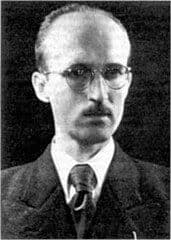 Jaroslaw Stetsko (1912-1986)During the funeral, NBN leader Yaroslav Stetsko delivered a speech in which he stated that:
[...] Bandera was a symbol of Ukraine's contemporary anti-Moscow struggle for an independent state and personal freedom, and that the Bandera phenomenon had grown beyond the framework of the revolutionary OUN, becoming a Ukrainian property, representing the entire fighting nation.
In another passage of the speech, Stetsko praised Bandera's religiosity as the motive for his struggle:
[...] Christianity was an inseparable element of his spirituality; faith in God and Christian morality were the main principles that guided him. His strong patriotism, his nationalism, were inextricably linked with Christianity. [...] He knew that we could only fight victoriously against Moscow, the center of militant, godless tyranny, if Ukraine proved its historical role in Europe.
Elsewhere: [...] This will be a fight for Christ against anti-Christian Moscow.
Stetsko concluded his speech with the words:
[...] Today we separate from Bandera's remains, but he will remain alive in our hearts, in the souls of the Ukrainian people, and THIS Stepan Bandera will not be taken from us by any brutal, physical force of barbaric Moscow.
 Jaroslaw Stetsko and Andrii Bandera during a conference in Munich, November 11, 1979I won't comment on all of Jaroslaw Stetsko's statements, but I would like to draw attention to the speaker's audacity, among other things, in praising the morality and Christian principles that supposedly guided this cruel, merciless murderer, who had nothing to do with God but was an emissary of Satan. This monster in human skin was turned into a martyr, a hero, a symbol of perfection and patriotism, but in reality, a cult of monstrous EVIL was created, directed primarily against Poles and Russians.
 The Veselka Choir commemorates the 1st anniversary of Stepan Bandera's death in Halifax, EnglandThe following year, 1960, on October 15th, two commemorative ceremonies were held in Toronto, in two churches. Similar ceremonies were held on October 15th and 16th in Boston, Chicago, Cleveland, Edmonton, London, Montreal, Munich, Ottawa, Philadelphia, and many other places.
In many places, Bandera's admirers raised symbolic coffins, performed national rituals, recited poetry, and sang religious, war, and nationalist songs in honor of Providnyk. Children dressed in traditional Cossack garb participated in the ceremonies. Horror, if such things were happening 66 years ago almost everywhere in the world, just one year after Bandera's death, what could be happening now in Ukraine, which is devoted to the cult of Bandera and supported by a vast Ukrainian diaspora, particularly from Canada, the United States, Great Britain, and Germany?
This concludes episode 12, "The False Idol," in which I described how Stepan Bandera's death was exploited to portray him as a martyr and hero of Ukraine. I cordially invite you to episode 13, "The Philatelists."
Photo source: Wikipedia