 PL
PL EN
EN#11Miraculous Conversion
Attempts to “whitewash” the image of the Organization of Ukrainian Nationalists after World War II.
 The main gate of the Sachsenhausen concentration campNinety years ago, in July 1936, a German Nazi concentration camp was established in the town of Sachsenhausen, approximately 30 km north of Berlin. Established on the orders of Heinrich Himmler, the camp operated until April 22, 1945. The SS, like Himmler, considered it a model camp in terms of organization. Therefore, a Concentration Camp Inspectorate was established within the camp, where, from 1938, many commandants and high-ranking SS officers trained, later holding positions in other camps.
At Sachsenhausen, criminal medical experiments were performed on prisoners, often resulting in death or disability. Among other things, in 1941, mass extermination experiments were conducted on Soviet prisoners using gas in trucks adapted for this purpose. Stepan Bandera was sent to this camp during World War II, along with a group of Ukrainian nationalists from the OUN-B. It turns out that this time, Stepan Bandera had no intention of making a "daring" escape like from the Polish "Alcatraz." The Ukrainians' collaboration with the Germans was close and long-lasting, although they tried to conceal it as best they could.
 OUN-B logoThe whitewashing campaign began as early as 1945. In May, OUN leaders issued an official statement denying any ties to fascist policies before and during World War II.
[...] The Ukrainian revolutionary liberation movement was not, and is not, a term associated with Italian Fascism and German National Socialism.
-368x500.jpg&w=750&q=75) Stepan Andriyovych Bandera (1909-1959)
Stepan Andriyovych Bandera (1909-1959)-337x500.jpg&w=750&q=75) Mykola Lebed (1909-1998)
Mykola Lebed (1909-1998)
Just before the publication of this statement, Bandera left Vienna for Innsbruck, located in the French occupation zone in Austria. While Bandera was in Innsbruck, the city was full of Ukrainian emigrants, particularly members of the OUN-B. On April 18, Bandera met with Yevhen Stakhiv and ordered him to go to the Croatian capital, Zagreb, to find Lebed and return him to Austria. Lebed traveled to Croatia as a representative of the OUN-B to establish contacts with Allied forces.
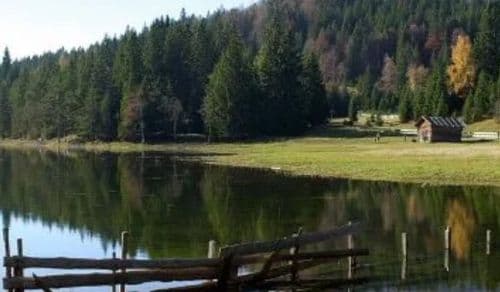 Seefeld region, TyrolIn the second half of 1945, Bandera moved to the Tyrol, to the Alpine province of Seefeld, close to the German border. He rented an entire floor of a villa, where he lived for many months with his bodyguard Mykhailo Andriiuk, his chauffeur Miklosh, and his secretary Marichka. One of the surnames Bandera used at the time was Karpiak, registered as a citizen in Innsbruck and Seefeld. Despite his criminal past, Bandera prospered.
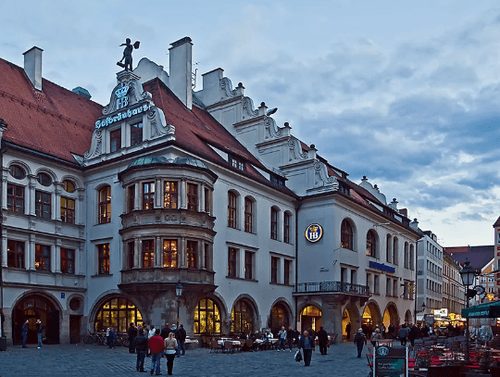 Munich, BavariaIn 1945, foreign OUN cells began organizing a new center in Munich, the capital of Bavaria, which was located in the American occupation zone of Germany.
Munich became the heart of Ukrainian emigration activity after World War II. Ukrainian social and political organizations were housed in a two-story building at 9 Dachauer Strasse. The first floor housed a Ukrainian church, and the second floor housed organizations such as the National Anti-Russian National Army (ABN), the publishing office of the Ukrainian newspaper "Ukrainskyi Samostiinyk" (Ukrainian Free Rifleman), the League of Political Prisoners, the Ukrainian Red Cross, Plast, and foreign OUN cells.
[...] In 1954, the foreign OUN cell and the ABN moved to 67 Zeppelinstrasse, where the OUN opened an editorial office and published the newspaper "The Road to Victory" (Shliakh Peremohy).
 A commemorative plaque in Bradford Cathedral, unveiled by Jarosław Stećko (chairman of the ABN), 1983The ABN, of which Stetsko was chairman, was not the National Security Agency, but the Anti-Bolshevik Bloc of Nations, an organization founded in November 1943.
The ABN headquarters organized anti-Soviet demonstrations and protests, as well as international conferences. Although the ABN was officially founded by Ukrainian nationalists, there is no doubt that the main inspiration for this international organization was the American secret services. There are documents indicating very strong ties between the ABN and the American CIA.
In countries such as the USA, Canada, and the United Kingdom, local ABN organizations existed (e.g., American Friends of the ABN). In other countries, such as Belgium, Italy, and Argentina, the ABN was represented by local branches and groups. The ABN was disbanded in 1996 after achieving its goals (i.e., the collapse of the Soviet Union). This organization included, among others, the Croatian Liberation Movement and the Organization of Ukrainian Nationalists (OUN-B, the Bandera faction). The most active member of the ABN was the Organization of Ukrainian Nationalists.
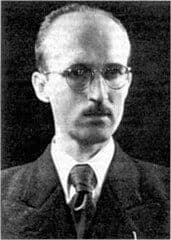 Jaroslaw Stetsko (1912-1986)Ukrainian Nationalists not only had powerful patrons, to whom I will return, but were also active in an international organization dedicated to the destruction of the Soviet Union. Who was the chairman of the National Security Agency, Yaroslav Stetsko?
[...] Stetsko studied philosophy and law at universities in Lviv and Krakow from 1929 to 1934, joined the Ukrainian Military Organization (UVO), and from 1932 was a member of the national executive and ideological officer of the OUN.
[...] After the Wehrmacht, including the Nachtigall Battalion, entered Lviv on June 30, 1941, and OUN-B activists announced the Declaration of Independence of Ukraine, he began forming a Ukrainian government, which lasted only twelve days.
The entire government was arrested by the Germans. Adolf Hitler was strongly opposed to the concept of establishing a Ukrainian state, planning to transform all Slavs into a slave labor force for the imperial Third Reich.
 Columns of prisoners in front of the Sachsenhausen camp gateBoth Stepan Bandera and Yaroslav Stetsko categorically refused to revoke Ukraine's Declaration of Independence. Consequently, in 1942, Stetsko was imprisoned in the Sachsenhausen concentration camp for political prisoners. He was released in September 1944 following the Germans' decision to form the Ukrainian National Army.
Towards the end of the war, wounded during a United States Army Air Force raid in the Czech Republic, he posed as the Prime Minister of Ukraine in the hospital and was detained by the partisans seizing power, who considered him a collaborator. He was saved from possible extradition by members of the OUN-B. After the war, he remained in exile in Munich – the Ukrainian Refugee Center, where he met his wife, Slava.
 Stepan Bandera's fake ID card in the name of Stefan PopelStepan Bandera used numerous false documents. For example, on June 6, 1945, he received an ID card bearing the name "Stefan Popel" from the Camp Committee of the Mauthausen concentration camp. According to this document,
[...] Bandera was a person who was held from September 15, 1941, to May 6, 1945, in Nazi-German concentration camps and was liberated from the Mauthausen concentration camp.
Stefan Bandera was never a prisoner in that concentration camp. Ukrainian emigrants in Germany often used pseudonyms at that time to avoid deportation to Soviet Ukraine. It is unclear whether Bandera took his pseudonym from the Ukrainian word "popil," meaning "ashes," or the name of the Ukrainian chess player "Stepan Popel," whose passport was allegedly stolen from his Paris apartment in 1944.
Bandera also used numerous press cards. One of them, dated October 15, 1950, confirmed that he was a correspondent for the newspaper "Ukrainian Independent" and lived in Söcking. Another, dated February 12, 1955, came from the French newspaper "L'Ukrainien." In 1947, Bandera used, among other things, a journalist's pass issued by the "Ukrainian Tribune" in Siedlce.
The question arises as to how Bandera obtained such a mass of false documents, allowing him to constantly assume new identities. One answer is his protectors, while the other, surprisingly, may be his imprisonment in the Sachsenhausen concentration camp, where he was imprisoned from 1943 to 1944. It turns out that in this camp, in the years 1942–1944, in barracks 18 and 19, separated by an additional fence, about 140 prisoners worked on forging British pounds, passports, visas, stamps and other documents.
 Reinhard Gehlen, last head of the German Military Intelligence FHOIn addition to using false documents, Bandera was protected by the American, British, and later West German intelligence services. American and British intelligence services were already interested in the Nazis and their collaborators before the end of the war. They were also interested in individuals and organizations, such as the German Military Intelligence for the Eastern Front (FHO) and various Eastern European far-right movements, including the OUN, who could provide information about the Soviet Union or who possessed other valuable knowledge.
With the help of the CIA, Reinhard Gehlen, former head of the FHO, established the Federal Intelligence Service (BND). American intelligence protected Gehlen and his advisors. Individuals like Bandera, who could either provide information about the Soviet Union, mobilize émigré circles with anti-communist propaganda, or had contacts with organizations behind the Iron Curtain, were of particular interest to American, British, and German intelligence services. Besides Ukrainians, there were Croats, Slovaks, Russians, Poles, Lithuanians, Latvians, Estonians, Romanians, and Hungarians who worked for Western intelligence services. The fact that some of them collaborated with the Nazis and were involved in war crimes was irrelevant, as long as they were useful in the Cold War.
 Harry Rositzke's book, CIA Covert OperationsAmerican and British intelligence had knowledge, though not always very precise, about the people they worked with. Harry Rositzke, former head of the CIA, commented on this in 1985:
[...] Exploiting every scoundrel, as long as he was anti-communist and possessed the zeal and willingness to recruit collaborators, meant that you probably wouldn't have looked too closely at their credentials either.
Ukrainian emigrants understood this situation and tried to make the most of it. Cooperation with Western intelligence services meant protection from legal proceedings for the OUN and, additionally, gained support for the fight against the Soviet Union.
The information provided explains why Ukrainian criminals, despite committing genocide, not only escaped punishment but also faced no legal proceedings. The criminals' services to American, British, and German intelligence services were more valuable than justice, truth, and the lives of the brutally murdered victims, most of whom were Poles.
 Stepan Bandera against the background of the Bandera flagA myth circulated among Ukrainian nationalists that Stepan Bandera was held in the German Sachsenhausen concentration camp under "inhumane" conditions. According to an interview with Bandera himself in 1950, he stated that
[...] he was held in Berlin by the Gestapo until 1943 and was then transferred to the Zellenbau building within the Sachsenhausen concentration camp, where he was assigned the number 72192.
Bandera, like some prominent members of the OUN, lived in luxurious conditions, compared to camp standards. Bandera had a separate cell, access to the camp library, a hairdresser, a tailor, a bakery, and could also receive parcels of food, clothes, and other items. These parcels were regularly sent to him by his wife, who lived in a Berlin apartment approximately 30 km from the camp. Bandera also had full contact with the OUN nationalists and the ability to send orders to them.
 One of the many monuments to Stepan Bandera in Ukraine in TernopilAlthough OUN-B members were well aware of the conditions their leader endured, both in Berlin and Sachsenhausen, for propaganda purposes they portrayed Bandera as a victim and martyr. One leaflet from 1942 stated that: [...] Bandera suffers for our ideas in basement prison cells.
Another leaflet from 1943 stated that:
[...] Stepan Bandera, Ukraine's best son and freedom fighter, was tortured by the Germans during his two years in prison.
Bandera was released on September 28, 1944, and temporarily detained in Berlin, under house arrest, with the right to possess weapons. Shortly thereafter, the Germans released the remaining OUN leaders, including Stetsko, Melnyk, Bulba Borovets, and approximately 300 other OUN members.
 Seal of the Central Intelligence AgencyIn January 2020, the CIA released a secret document dated December 6, 1951, concerning Stepan Bandera, titled "Stepan Bandera and the Ukrainian State in 1941." The document was authored by historian Petro Yarovyy. The document states, among other things, that
[...] On June 30, 1941, Ukrainian fascist and professional spy for Hitler, Stepan A. Bandera (codenamed Consul II), announced the establishment of a Ukrainian State in Eastern Ukraine in German-occupied Lviv. On the same day, the government of this state was established, with Yaroslav Stetsko, Bandera's deputy, as prime minister.
The document continues:
[...] S. A. Bandera emerged on the Ukrainian political scene in June 1934, when, as leader of the OUN (Organization of Ukrainian Nationalists), he ordered the assassination of Polish Minister of Internal Affairs Pieracki. It's worth noting that although the perpetrator of this act, Grigoriy Matseyko, was not arrested, Polish police immediately had sufficient information to begin operations against OUN leaders, with Bandera at the top of the list. This indicates that the evidence and information about the OUN's revolutionary and terrorist activities did not come from the murderer but from other sources.
This concludes episode 11, "Miracle Conversion," in which I described attempts to whitewash Ukrainian criminals, the fate of Bandera after the end of World War II, and provided information about the protectors of genocide. I cordially invite you to the next episode, "The False Idol."
Photo source: Wikipedia