 PL
PL EN
EN#13Philatelists
OUN propaganda action on the second anniversary of Stepan Bandera's death.
 The most expensive stamp in the world - British Guiana One-Cent Magenta170 years ago, in 1856, a one-cent stamp was printed in the British colony, which, 158 years later, turned out to be the most expensive stamp in the world. This stamp, the "British Guiana One-Cent Magenta," sold for a staggering $9.48 million at auction at the renowned Sotheby's auction house in New York on June 17, 2014. The stamp's history reveals that British stamps were used in the colony, but their delivery was delayed. Consequently, the local post office asked a newspaper publisher to print replacement one- and four-cent stamps. The stamps were printed, but they did not meet postal workers' expectations. To avoid counterfeits, they decided to initial the stamps by a postal clerk. This is how the initials E.D.W. (E.D. Wight) appeared on the stamps. The stamp was printed on weak paper, canceled, and octagonally trimmed, but due to its rarity, it always commanded high prices at the stock exchanges. The stamp's last owner was the du Pont industrialist family.
The second most valuable stamp is currently "The Three-Skilling Yellow," which fetched $2.3 million in 1996. The stamp was a misprinted stamp from 1855. While most stamps in this series were blue-green, this one was yellow, and only a single copy remains. Some stamp enthusiasts, philatelists, treat stamps as a form of investment, and stamps representing seemingly little material value, like scraps of paper, can be much more valuable than gold or diamonds. Postage stamps are used to settle postal bills and usually take the form of a paper rectangle affixed to an envelope, although oval, triangular, and pentagonal stamps are also available. Could stamps, besides paying for postage, also serve purposes most letter-senders would never consider? I'll discuss this seemingly unusual use of stamps in this episode.
 Cindirella stamps with Stepan Bandera, 2022On the second anniversary of Bandera's death, the OUN launched a propaganda campaign to popularize the Bandera cult. The émigré institution, calling itself the "Underground Mail of Ukraine," issued four stamps "featuring Cinderella." Some might ask what Cinderella has to do with Bandera, so let me explain: Cinderella stamps, or "cindirella stamps," are stamps issued by non-governmental institutions for advertising, propaganda, or charitable purposes. Therefore, they almost never depict images of Cinderella.
 Contemporary stamps with Stepan BanderaThe first stamp showed Bandera as a school-age boy, the second Bandera after his release from a Polish prison. The third featured a bust of Bandera as a politician during World War II. The World War II era was described on this stamp as follows:
[...] When, under Bandera's banner, 200,000 UPA and OUN soldiers waged a relentless battle against the two occupiers of Ukraine – the Nazis and the Muscovites.
Well, another brazen propaganda lie by the OUN about the alleged fight against the Germans. The last stamp depicted Bandera after World War II.
The stamps were distributed by a Ukrainian group of emigrants called SUM, about whom a Ukrainian newspaper wrote:
[...] This is a generation preparing to take up Bandera's banner, to fight for Ukraine's sovereignty and independence, and following the path set by Provydnik Stepan Bandera.
The newspaper encouraged readers to affix stamps to letters they sent to friends. The stamps were distributed in Australia, Belgium, Canada, France, Germany, Great Britain, and the United States.
 Sao Paulo, Brazil todayAs with the first anniversary, the second anniversary also saw numerous commemorations around the world commemorating Bandera's death. For example, in São Paulo, Brazil, the Greek Catholic Church made a symbolic coffin decorated with flowers, and nuns placed a trident of rose petals on the coffin. It's worth noting that the Church that promoted Bandera's cult was the Greek Catholic Church, and nothing has changed, even in modern times.
-302x304.jpg&w=640&q=75) Joseph Stalin (1879-1953)
Joseph Stalin (1879-1953)
In 1961, Bandera's assassin was identified.
[...] On November 17, 1961, German authorities revealed who killed Bandera and how. The OUN organized a press conference to brief journalists on the details of the assassination. Ukrainian nationalists published an article comparing Bandera's assassination to the assassinations of Petliura in 1926 and Konovalets in 1938 and portraying the Soviet Union as a country continuing Stalin's policies.
As a reminder, Joseph Stalin died on March 5, 1953, almost six years before Bandera's assassination (October 15, 1959). Immediately after the identity of Bandera's assassin was revealed, Ukrainian organizations and committees around the world began organizing demonstrations against the Soviet Union.
-277x374.jpg&w=640&q=75) Aleksandr Shelepin (1918-1994)The day after the murder of Stepan Bandera was revealed:
Aleksandr Shelepin (1918-1994)The day after the murder of Stepan Bandera was revealed:
[...] On November 18, 1961, 1,500 activists met in Bradford, Great Britain, where they demanded, for the murder of their friend, Providnyk, a clean slate, and the commencement of the trial of Alexandr Shelepin, head of the KGB, and Nikita Khrushchev, First Secretary of the Communist Party of the Soviet Union and Chairman of the Council of Ministers of the CPSU.
Under a large photograph of Bandera, a Ukrainian newspaper published a photo of Shelepin as the mastermind of the crime and Stashynsky as the executor. The next issue featured an article claiming Stetsko could be the next victim of the murder. Meanwhile, page 3 of the newspaper published Petro Kizko's poem "Not Enough Revenge," in which the author demands "such punishment for Moscow that its flames should burn it for all eternity."
-373x500.png&w=750&q=75) Nikita Khrushchev (1894-1971)Notice the sheer volume of hatred, political propaganda, calls for violence and war—well, these are typical components of the Organization of Ukrainian Nationalists' ideology. The following day...
Nikita Khrushchev (1894-1971)Notice the sheer volume of hatred, political propaganda, calls for violence and war—well, these are typical components of the Organization of Ukrainian Nationalists' ideology. The following day...
[...] On Sunday, November 19, 1961, anti-Soviet and anti-communist demonstrations took place in Munich, Edmonton, Derby, Port Arthur, and Port William. On Saturday, November 25, demonstrations took place in seven locations around the world. According to OUN historians, by the end of 1961 and early 1962, the Ukrainian diaspora had held 132 anti-Soviet and anti-communist demonstrations.
-500x312.jpg&w=1080&q=75) Student protests in Germany (1967–1968)[...] During the demonstrations in London on November 25 and 26, 1961, activists carried banners reading "The blood of the Ukrainian leader is on Khrushchev's hands," "Today Khruschev is killing Ukrainians, and tomorrow it could be you," "The future of your children is threatened by the oppressors of Ukraine," "Communism is another form of Russian imperialism," and so on.
Student protests in Germany (1967–1968)[...] During the demonstrations in London on November 25 and 26, 1961, activists carried banners reading "The blood of the Ukrainian leader is on Khrushchev's hands," "Today Khruschev is killing Ukrainians, and tomorrow it could be you," "The future of your children is threatened by the oppressors of Ukraine," "Communism is another form of Russian imperialism," and so on.
Propaganda leaflets were also distributed, Soviet flags were burned, and Soviet embassy buildings were stormed. In short, violence, propaganda, and the incitement of hatred towards the Soviet Union. I should point out that I am speaking of a time 65 years ago, and the anti-Soviet policies cultivated at that time have not changed at all, as if someone had stopped time and no changes had occurred in the contemporary Russian Federation.
[...] During some demonstrations, protesters joined the so-called freedom fighters from Soviet republics such as Estonia, from which Waffen-SS soldiers and Nazi collaborators also moved to North America after World War II.
-187x270.jpg&w=384&q=75) Boghdan Stashinsky (born 1931)A few words about Stepan Bandera's assassin, Boghdan Stashinsky.
Boghdan Stashinsky (born 1931)A few words about Stepan Bandera's assassin, Boghdan Stashinsky.
Stashinsky, a Ukrainian national, was recruited by the KGB at the age of 19 while studying at Lviv University. He had previously been associated with the nationalist group OUN and helped spread anti-Soviet propaganda. The assassin used a pistol loaded with prussic acid. He successfully assassinated Bandera only on his second attempt, on October 15, 1959, in Munich. His next victim was supposed to be Yaroslav Stetsko, but he did not carry out this order, reportedly at the urging of his East German wife, Inga Pohl. On August 12, 1961, he reported to the Americans in West Berlin. Tried and sentenced in 1962 to eight years in prison, he was released early in 1966. According to official sources, he was secretly transported by CIA agents to the United States, where he and his wife were given new identities. In fact, he settled in South Africa.
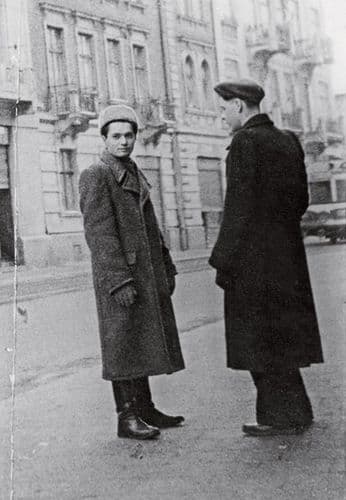 Boghdan Stashinsky with a friendHis biography could be described in James Bond style. But are these generally known facts accurate? Let's try to analyze them in a concise form, pointing out certain doubts.
Doubt 1. Stashinsky was Ukrainian, and his ties to the OUN have been confirmed. This raises the question of whether he played the role of a double agent for the USSR and the OUN?
Doubt 2. He made two attempts to assassinate Bandera. This means that Bandera was fully aware of the potential threat after the first attempt, but he failed to react at all, or at least not effectively.
Doubt 3. Was it a wise move for the USSR to order Bandera's assassination? Here we have at least two logical arguments denying USSR involvement. First, such an assassination would have sparked waves of hatred not only from Ukrainians but also from other countries linked to Ukraine. Second, the assassination turned Bandera into a martyr and hero, which was even worse for the USSR's image. Therefore, from a logical perspective, ordering Bandera's assassination was not at all in the interests of the USSR.
Doubt 4: The suspicious behavior of the Americans protecting Stashinsky, providing him with legal, financial, and logistical support, even though he was an assassin working for their archenemy, the Soviet Union.
Doubt 5: Finally, a completely incomprehensible question: Why did Ukrainian nationalists, with their powerful intelligence apparatus operating practically worldwide, Ukrainian media, sponsors, and almost unlimited financial resources, not take revenge on their murderer, Provydnyk? It seems as if the assassin either acted on their orders, or Bandera's assassination was staged and his double was killed, which in both cases clearly indicates the involvement of the OUN.
 The book "The Grey Wolf: The Escape of Adolf Hitler"For example, let me remind you of another historical fact and the lack of a clear answer to the question of whether the German watercolor painter (Adolf Hitler) actually committed suicide with Eva Braun in a Berlin bunker on April 30, 1945. Simon Dustan and Gerrard Williams deny this fact in their book "The Grey Wolf: The Escape of Adolf Hitler."
Couldn't this hypothetically have happened in Bandera's case? Even if we ignore historical truth, comparing the deaths of the Adolf Hitler and Stepan Bandera, the former's actions are unequivocally condemned, and Bandera is glorified to this day not only in Ukraine but almost everywhere in the world. In any case, the officially presented historical facts related to Bandera's assassination are inconsistent and have little to do with logic. Let's leave the solution of this mystery to brighter minds, like Sherlock Holmes, and let's return to the OUN, energetically expanding its business interests around the world.
 Female members of SUM, UK 17/10/2009[...] Using Bandera's death as a pretext, the OUN established a foundation called the Stepan Bandera Liberation Struggle Fund. The organization raised approximately $50,000 and used the funds to publish propaganda historical literature, such as "Russian Colonialism in Ukraine" and "Murdered by Moscow: Petliura, Konovalets, Bandera." On July 22, 1962, the Stepan Bandera Ukrainian House opened in Villa Adelina, Argentina. On the same day, a monument to the Heroes of Ukraine was unveiled in Ellenville, New York.
Here are other OUN propaganda campaigns:
[...] The OUN organized camps for Ukrainians with the aim of "educating Ukrainian youth and local communities to serve God and their Ukrainian land." Five such camps—Veselka, Verkhovyna, Bilohorshcha, Karpaty, and Dibrova—were opened in North America.
[...] On October 17, 1964, 500 Ukrainians arrived in Washington, D.C. They laid a wreath at the Shevchenko monument and sang nationalist songs. They then proceeded to the Soviet Embassy and picketed for three hours, singing Bandera songs and waving banners reading "God bless America, God liberate Ukraine."
 Canadian SUM, Prolisok choir performing on October 17, 2009 at the Anton Fingerle Educational Center in MunichThe events presented, my dear friends, have unfolded almost unchanged every year since 1959. There is no doubt that the enormous funds necessary to carry out such actions are provided to the nationalists by their sponsors. Questions arise as to who truly ordered the murder of Provydnyk Stepan Bandera, if it wasn't a staged play? A play that portrayed the criminal Bandera as a martyr and hero. Moreover, the killer was Ukrainian, and his actions were in fact aligned with the interests of Ukrainians, who, although always vengeful, miraculously spared the murderer this time!!!
This concludes episode 13, "The Philatelists," in which I described the actions of OUN nationalists promoting the cult of Bandera worldwide and raised questions surrounding Stepan Bandera's death. I cordially invite you to watch the next episode, episode 14, titled "Big Party in Washington."
Photo source: Wikipedia